


Tourism
Tanzania's tourism sector reached a record USD 3,948.2 million in earnings in 2025 on 2.29 million international arrivals (+7.1% YoY), contributing 17.2% of GDP and 25% of foreign exchange earnings while sustaining approximately 3.6 million direct and indirect jobs.[2]
Tanzania is Africa's leading safari and beach destination, anchored by world-renowned attractions such as Serengeti National Park, Ngorongoro Crater, Mount Kilimanjaro, and the Zanzibar archipelago.
Tourism is the country's primary source of foreign exchange, generating 25% of total foreign exchange earnings, 22.4% of total exports, and 17.2% of GDP in 2024, while supporting roughly 3.6 million direct and indirect jobs.[2]
International arrivals reached 2.29 million in 2025, up 7.1% year-on-year and 50.2% above pre-pandemic levels, while tourism earnings climbed to USD 3,948.2 million from USD 3,903.1 million in 2024.[1]
Tanzania was named Africa's Leading Destination 2025, Serengeti National Park was crowned Africa's Best Safari Park, Mount Kilimanjaro voted the continent's Leading Tourist Attraction 2024, and Zanzibar named Africa's Leading Beach Destination 2025—accolades underpinning a major investment cycle across all four tourism circuits.
Flagship projects underway include the REGROW Project diversifying the Southern Circuit, the KAMACO Project unlocking the Western Circuit, Smart Gates digitalising the Northern Circuit gateways, the new Msalato International Airport in Dodoma, and 337 newly identified tourist attractions across Mtwara, Lindi, and Njombe being prepared for investor development with World Bank support.
Tanzania's climate strongly supports year-round tourism—the June to September long dry season offers the most favourable game viewing with clear skies and accessible roads, while the January-February short dry spell delivers exceptional viewing of newborn animals during the calving season.
Tourist Arrivals and Source Markets
International tourist arrivals reached 2.29 million in 2025, a 7.1% increase from 2.14 million in 2024 and 50.2% above pre-pandemic levels, while tourism earnings rose to USD 3,948.2 million from USD 3,903.1 million the year before.[1]
International arrivals have surged 78.6% over the 2016-2025 decade, with Zanzibar alone welcoming 917,167 international visitors in 2025, up 24.5% from 736,755 in 2024.
In 2024, Europe led source regions with 784,759 visitors (36.6%), followed by the Americas with 188,786 (8.8%), East Asia and the Pacific 116,837 (5.5%), Africa 94,057 (4.4%), South Asia 73,544 (3.4%), and the Middle East 37,399 (1.7%).[3]
The top mainland source markets in 2024 were the United States (15.0%), Italy (11.8%), Kenya (8.8%), France (7.3%), United Kingdom (6.4%), Spain (5.3%), Germany (4.9%), Zambia (3.3%), Burundi (3.3%), South Africa (3.2%), DRC (3.1%), China (3.0%), Zimbabwe (2.4%), Australia (2.1%), and Canada (2.0%).[4]
China entered the top 15 source markets for the first time in 2024, propelled by the 'Amazing Tanzania' documentary launched in Beijing featuring President Samia Suluhu Hassan and Zanzibar President Hussein Ali Mwinyi, reaching an estimated 1.2 billion viewers.
For Zanzibar, the top markets were Italy (15.5%), France (12.3%), United Kingdom (9.0%), and Spain (7.5%), with Kenya and South Africa as the leading African contributors.
By mode of arrival, 64.7% entered by air, 33.6% by land, and 1.7% by water—with air arrivals split between Zanzibar International Airport (42.7%), Julius Nyerere International Airport in Dar es Salaam (34.3%), and Kilimanjaro International Airport (23.0%).
Leisure dominated purpose of visit at 86.8%, followed by visiting friends and relatives (7.1%), transit (5.0%), and business (0.8%), with quarterly arrivals in 2024 distributed as Q1 24.3%, Q2 19.8%, Q3 28.7%, and Q4 27.2%—peaking in July-August and December.[5]
Safari and National Parks
Wildlife is the backbone of Tanzania's tourism offering, anchored by globally recognised icons including Serengeti National Park, Ngorongoro Crater, and Mount Kilimanjaro.
Tanzania was named Africa's Leading Destination in 2025,[8] Serengeti has been crowned Africa's Best Safari Park for several consecutive years,[9] and Mount Kilimanjaro was voted the continent's Leading Tourist Attraction in 2024.[10]
40.5% of Tanzania's land area is designated as protected, encompassing 22 national parks, the Ngorongoro Conservation Area, 22 game reserves, 28 game-controlled areas, 38 Wildlife Management Areas, three Ramsar sites, 465 forest reserves, 19 nature forest reserves, 23 forest plantations, 133 cultural heritage sites, and seven museums.[11]
Tanzania's tourism is organised across four circuits—the Northern Circuit (the most developed and popular), the Southern Circuit (vast inland wilderness), the Western Circuit (Lake Tanganyika and Lake Victoria), and the Coastal and Marine Circuit (the Indian Ocean coastline, Zanzibar, and Mafia).
Ngorongoro, Serengeti, and Tarangire in the Northern Circuit are the most visited parks—Ngorongoro is the world's largest intact caldera, Serengeti hosts the annual wildebeest migration, and Tarangire has one of the largest elephant concentrations globally.
Coastal destinations, Zanzibar's beaches and Stone Town, and the Northern Circuit parks together account for approximately 63% of total visitors, while visitor expenditure averages USD 460 per person per day for hunters, USD 399 for wildlife safari visitors, and USD 179 for beach tourism.
Zanzibar Beach Tourism
Zanzibar was named Africa's Leading Beach Destination in 2025,[12] welcoming 917,167 international visitors during the year—a 24.5% jump from 736,755 in 2024—with Nungwi, Kendwa, Kiwengwa, and Paje ranking as the most popular beaches.
Stone Town, the historic, cultural, and heritage centre of the archipelago, remains a major draw alongside the white-sand beaches.
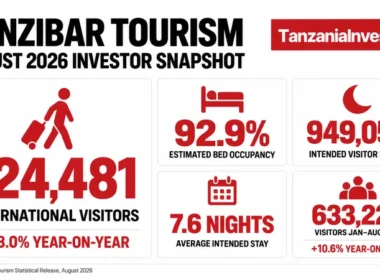
The average length of stay in Zanzibar reached 7 nights in 2024 (up one night from 2023), with 55% of visitors staying 8 to 14 nights and 24.3% staying 15 to 28 nights, predominantly for leisure.
Average visitor expenditure in Zanzibar stood at USD 251 per person per night in 2024, down slightly from USD 257 in 2023, while visitors from Italy, Spain, South Africa, Germany, and the Netherlands recorded the longest stays at 8 nights on average.
First-time arrivals accounted for 84.4% of Zanzibar's visitors, with repeat travellers making up the remaining 15.6%—pointing to substantial scope for loyalty-building and premium repeat-stay products.
Hotels and Accommodation
Tanzania had 293 registered and licensed tourist-class hotels in 2023, offering 25,045 rooms and 44,091 beds across hotels, motels, camps, lodges, apartments, and guesthouses.[6]
Dar es Salaam leads in accommodation capacity, with the city's large five-star hotels providing a combined 1,092 rooms, supported by a growing pipeline of commercial properties and serviced apartments.
Average bed occupancy for September 2024-August 2025 reached 61.83%, peaking at 70.7% in December—occupancy was highest between August and January and declined in the first quarter to a low of 51.5% in April.[7]
The mainland average length of stay held at 10 nights in 2024, unchanged over five years, with 43% of visitors staying 8 to 14 nights and 31.5% staying 4 to 7 nights.
Mainland average visitor expenditure was USD 243 per person per night in 2024 (down from USD 250 in 2023), with holidaymakers spending USD 290.7 and business visitors USD 226.7—while Chinese visitors recorded the highest expenditure at USD 492 per person per night, followed by Canada at USD 346 and the United States at USD 345.
Aviation and Air Connectivity
64.7% of international visitors arrive by air, with Zanzibar International Airport handling 42.7% of air arrivals, Julius Nyerere International Airport in Dar es Salaam 34.3%, and Kilimanjaro International Airport 23.0%.
Tanzania's main aviation hubs are Julius Nyerere International Airport, Kilimanjaro International Airport, Abeid Amani Karume International Airport in Zanzibar, and the new Msalato International Airport under construction in Dodoma.
International carriers serving Tanzania include Air Tanzania, Emirates, Etihad, Kenya Airways, Qatar Airways, KLM, Turkish Airlines, and Ethiopian Airlines, providing strong long-haul connectivity from Europe, the Gulf, Africa, and Asia.
Air Tanzania continues to expand its fleet and route network, complementing the strong international carrier presence at the three main gateway airports and supporting the country's positioning as a regional aviation hub.
Policies
The Ministry of Natural Resources and Tourism (MNRT) leads sector governance, with the Tanzania Tourist Board (TTB) responsible for marketing and promotion both regionally and internationally.
Tanzania's first National Tourism Policy was adopted in 1991 and revised in 1999 to promote high-quality tourism that is culturally and socially acceptable, environmentally sustainable, and economically viable—the policy's initial target of one million arrivals by 2010 was achieved in 2012 at 1,077,058 visitors.
The MNRT Strategic Plan 2021/22-2025/26, aligned with FYDP III, Vision 2025, Vision 2050 and SDGs 2030, targets 5,000,000 regional and international arrivals, the upgrading of 15 Game Controlled Areas to Game Reserves, the establishment of eight new Wildlife Management Areas, and an increase in designated resident hunting blocks from eight to 13.
The strategy expands tourism products and diversifies into new segments such as cruise tourism and MICE (Meetings, Incentives, Conferences, Exhibitions), while the 2025/26 Ministry budget prioritises diversifying tourism circuits beyond the traditional Northern route.
In the Southern Circuit, the World Bank-supported REGROW Project (Resilient Natural Resources Management for Tourism and Growth) targets Nyerere, Mikumi, Ruaha, and Udzungwa Mountains National Parks with airport and airstrip upgrades, the new Southern Tanzania Destination Marketing Center at Kihesa Kilolo in Iringa, and new tourist accommodations.
In the Western Circuit, the KAMACO Project supports conservation of Katavi and Mahale National Parks and their connecting corridor, complemented by new water-based routes linking Saanane Island, Rubondo Island, and the Serengeti via the Speke Gulf.
In the Northern Circuit, major concrete and gravel roads improvements are advancing across Serengeti and Ngorongoro, alongside 'Smart Gates' at Serengeti, Tarangire, and Arusha National Parks to streamline visitor flow and revenue collection, and the restoration of the Ngorongoro-Lengai UNESCO Global Geopark status.
In the Coastal Circuit, high-potential routes are being developed across South-East and Eastern zones, including the Humpback Whale migration in Msimbati (Mtwara), the German Boma historical site in Lindi, and the Kilwa Kisiwani and Songo Mnara ruins—linked by improved ports infrastructure and the SGR network.
The Tanzania Investment and Special Economic Zones Authority (TISEZA) serves as the one-stop facilitator for tourism investment projects, replacing the former Tanzania Investment Centre (TIC) and supporting Public-Private Partnership (PPP) structures across the sector.
Investment Opportunities
Accommodation presents strong opportunities through hotel capacity expansion in established destinations and greenfield development in untapped locations—including urban centres such as Dodoma, sites inside and adjacent to national parks, properties along the 850-mile mainland coastline from Bagamoyo and Kigamboni southwards, and Zanzibar's beaches. Adjacent demand is rising for commercial properties, worker housing for tourism staff, mortgage financing, and public-led housing schemes.
Tourist services span tour operators and travel agencies, air and ground transport (including rapid-transit links and airport feeder services), conference tourism facilities, leisure and theme parks, golf courses, sea and lake cruising, trophy hunting, and eco-tourism facilities, complemented by sewerage and water infrastructure for new resort developments.
Specialised tourism segments—beach tourism, cultural and historical sites, MICE, and cruise tourism—are diversifying Tanzania's offering for both domestic and international visitors, in line with Vision 2050 targets to rank Tanzania among the top three African destinations.
337 newly identified tourist attractions across Mtwara, Lindi, Njombe and other regions are being registered for investor development and promotion,[13] while Smart Gate technology rollouts for Serengeti, Tarangire, and Arusha National Parks open ICT investment opportunities in visitor flow management and revenue collection systems.
Southern Circuit infrastructure—including airports, airstrips, the Kihesa Kilolo marketing centre, and new accommodations supporting anticipated visitor growth under regional growth programmes—creates a substantial pipeline of bankable projects. Complementary openings exist in iron and steel for construction inputs, Lindi LNG-linked corporate travel demand, and roads connecting tourism circuits nationwide.
Last Update: May 2026
References
- https://www.bot.go.tz/Publications/Regular/Monthly%20Economic%20Review/en/2026020312553210.pdf (Guide reference #12)
- https://www.maliasili.go.tz/assets/pdfs/HOTUBAYABAJETIYAWIZARAKWAMWAKA2025-2026_updated.pdf (Guide reference #170)
- https://www.maliasili.go.tz/assets/pdfs/2024MaliasiliStatisticalBulletin.pdf (Guide reference #171)
- https://www.bot.go.tz/Publications/Other/Tanzania%20Tourism%20Sector%20Survey%20Report/sw/2025082910055206.pdf (Guide reference #172)
- https://maliasili.go.tz/assets/pdfs/2024MaliasiliStatisticalBulletin.pdf (Guide reference #173)
- https://www.popi.go.tz/uploads/documents/en-1729763797-NATIONAL%20INVESTMENT%20REPORT%202023.pdf (Guide reference #174)
- https://www.nbs.go.tz/uploads/statistics/documents/en-1769161667-HOTEL%20Statistics%20Release_August,%202025%20.pdf (Guide reference #175)
- https://www.worldtravelawards.com/award-africas-leading-destination-2025 (Guide reference #176)
- https://www.safaribookings.com/blog/260 (Guide reference #177)
- https://www.worldtravelawards.com/award-africas-leading-tourist-attraction-2024 (Guide reference #178)
- https://www.tfs.go.tz/uploads/documents/Ministry_of_Natural_Resources_and_Tourism_Strategic_Plan_202122_202526.pdf (Guide reference #179)
- https://www.worldtravelawards.com/award-africas-leading-beach-destination-2025 (Guide reference #180)
- https://www.maliasili.go.tz/assets/pdfs/HOTUBAYABAJETIYAWIZARAKWAMWAKA2025-2026_updated.pdf (Guide reference #186)
Want to know more about Tourism in Tanzania? Our free overview of the Tanzania Business and Investment Guide 2026 covers Tourism, plus key sectors and investment opportunities. The complete 141-page edition includes policies, taxation, key regulations, full macroeconomic data, and sources, and is also available at no cost upon completion of a short form.
Download Free OverviewGet the Full Edition for Free