

Hydropower
As of December 31, 2025, Tanzania's installed electricity capacity reached 4,532.66 MW, with hydropower accounting for 58.20% of the generation mix following the full commissioning of the 2,115 MW Julius Nyerere Hydropower Plant.[1]
Hydropower is the backbone of Tanzania's electricity generation, drawing on a national potential estimated at around 4,700 MW.
Only 837.77 MW of this potential has been exploited to date, leaving substantial headroom for new project development.[6]
The commissioning of the Julius Nyerere Hydropower Plant on the Rufiji River in 2025 marked a structural shift in the country's power system, raising total generation capacity above 4,000 MW and reinforcing hydropower's dominance in the energy mix.
Contents
Hydropower in the National Generation Mix
As of December 31, 2025, Tanzania's installed electricity capacity stood at 4,532.66 MW against an electricity demand of 2,505.86 MW.[1]
Total energy generation reached 8,501.78 GWh, with a reserve margin of 51.02%, well above the target threshold of greater than 15%.
Hydropower supplied 58.20% of the generation mix, followed by natural gas at 34.73%, liquid fuel at 4.12%, coal at 2.93%, biomass at 2.68%, solar at 0.23%, and wind at 0.06%.
Power plant availability was recorded at 73.25%, below the target of greater than 88%, while overall plant utilization stood at 31.98%.
The high reserve margin and moderate utilization reflect the recent commissioning of new capacity, signalling further scope to convert installed hydropower into dispatched energy.
The Julius Nyerere Hydropower Plant
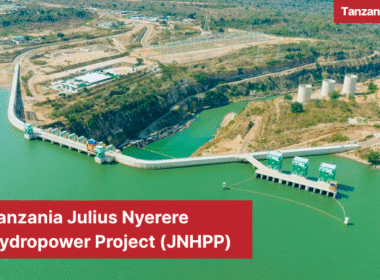
The Julius Nyerere Hydropower Plant is a USD 3 billion Government-led initiative designed to increase energy reliability for industrial and domestic use.
Located on the Rufiji River, the dam is the fourth largest in Africa and ninth globally, with an installed capacity of 2,115 MW.
Reaching full operation in 2025, the project raised Tanzania's total generation capacity to over 4,000 MW.
The plant is expected to alleviate power shortages, enhance energy security, and reduce electricity costs, directly supporting Tanzania's industrialization agenda.
Its full commissioning is the single most important driver behind the shift of hydropower to a dominant 58.20% share of the generation mix in 2025.[1]
Hydropower Potential and Untapped Capacity
Tanzania has a large hydropower potential of around 4,700 MW.[6]
Of this, only 837.77 MW has been exploited so far, meaning that more than 80% of the resource base remains available for development.
This gap between potential and installed capacity positions hydropower as the largest single reservoir of untapped, low-cost renewable electricity in the country.
The resource is complemented by geothermal potential estimated at over 5,000 MW, solar irradiation of 1,800 to 2,400 kWh per square meter per year, and wind areas with average speeds above 8 m/s in central and western regions.
Transmission Backbone Supporting Hydropower
Electricity generated by hydropower plants is evacuated through a national high-voltage transmission network of 8,303.87 km, spanning voltages from 66 kV to 400 kV.[1]
The system includes 72 substations with a combined capacity of 10,226.7 MVA.
Reliability metrics show a System Average Interruption Frequency Index (SAIFI) of 1.1 incidents, within the target of fewer than 10 incidents.
The System Average Interruption Duration Index (SAIDI) was 0.3 hours, indicating a stable evacuation platform for hydropower output.
Policy Framework
National Renewable Energy Strategy 2024,2034
The National Renewable Energy Strategy (2024,2034), developed by the Ministry of Energy in line with NEP 2015, coordinates and integrates renewable energy across sectors.[7]
The strategy drives the National Energy Compact's objective to increase renewables from 61.8% to 75% of the generation mix by 2030.
By 2038, it targets a total renewable generation capacity of 6,130 MW, of which 3,160 MW is to come from hydropower, alongside 1,340 MW from solar, 1,150 MW from wind, and 480 MW from geothermal energy.
Vision 2050 Energy Accelerator
Under Tanzania Development Vision 2050, Accelerator 2 targets reliable, affordable, and clean energy by expanding hydropower, solar, wind, and natural gas capacity to achieve 90% electricity access by 2050.
The plan also seeks to improve transmission and distribution networks and reduce reliance on biomass fuels.
Universal Access Target
The national utility is undergoing various rehabilitation and reinforcement projects with the goal of increasing electricity connectivity to 75% by 2030 and achieving universal access by the same year.[5]
Total installed capacity is projected to grow from 4,181.71 MW in 2025 to 11,822.39 MW by 2050 in order to meet forecasted demand.[1]
Investment Opportunities
The gap between Tanzania's 4,700 MW hydropower potential and the 837.77 MW currently exploited represents the single largest renewable investment opening in the country.
The National Renewable Energy Strategy target of 3,160 MW of hydropower by 2038 implies more than a threefold expansion of installed hydro capacity from current levels, creating a long project pipeline for developers, EPC contractors, and equipment suppliers.
Grid expansion is a parallel opportunity, with total installed capacity projected to rise from 4,181.71 MW in 2025 to 11,822.39 MW by 2050, requiring new transmission lines, substations, and interconnectors to evacuate hydro output.
Water demand for hydropower alongside agriculture, mining, and environmental services is rising, supporting investment in dam infrastructure, catchment management, and multi-purpose water storage projects.[4]
Additional openings exist in mini-hydro and off-grid hydropower solutions to complement rural electrification, where all 12,318 mainland villages are already connected and 33,657 out of 64,359 hamlets have grid access.[2]
The Public-Private Partnership framework provides a structured route for private capital into hydropower generation, transmission, and distribution, combining public oversight with private sector efficiency, technology, and capital.[3]
Last Update: May 2026
References
- https://www.ewura.go.tz/uploads/documents/en-1771937532-Electricty%20Sub-Sector%20Performance%20Updates_Dec_2025.pdf (Guide reference #15)
- https://www.nishati.go.tz/uploads/documents/en-1745835421-HOTUBA%20YA%20BAJETI%20%20MWAKA%202025-26%20-.pdf (Guide reference #31)
- https://ppp.worldbank.org/sites/default/files/2024-07/Tanzania_PPP%20Policy.pdf (Guide reference #75)
- https://www.ewura.go.tz/uploads/documents/en-1743160797-Water%20Utilities%20Performance%20Review%20Report%202023-24%20Final.pdf (Guide reference #86)
- https://tims.tanesco.co.tz/portal (Guide reference #98)
- https://www.nishati.go.tz/uploads/documents/en-1754048957-National%20Renewable%20Energy%20Strategy%202024%E2%80%932034.pdf (Guide reference #99)
- https://www.nishati.go.tz/uploads/documents/en-1754049550-National%20Renewable%20Energy%20Strategy%202024%E2%80%932034.pdf (Guide reference #102)
Want to know more about Hydropower in Tanzania? Our free overview of the Tanzania Business and Investment Guide 2026 covers Hydropower, plus key sectors and investment opportunities. The complete 141-page edition includes policies, taxation, key regulations, full macroeconomic data, and sources, and is also available at no cost upon completion of a short form.
Download Free OverviewGet the Full Edition for Free