Housing
Tanzania faces a current housing deficit of 3,000,000 units, with annual demand rising by 200,000 units and an annual shortfall of 390,981 houses, pointing to a requirement of 26,840,909 housing units by 2050 to accommodate projected population growth.[2][3][6]
Housing is one of the most structurally under-supplied segments of Tanzania's real estate market, driven by rapid demographic expansion and accelerating urbanisation.
The population reached 62.7 million at the 2022 Population and Housing Census and is currently estimated at around 70 million, growing at 3.2% per year and projected to double to approximately 123.4 million by 2044.[1]
Urbanisation is reshaping demand: 34.9% of Tanzanians now live in urban areas, up from 23.1% in 2002, and Dar es Salaam is 100% urban.
Contents
Housing Demand and Deficit
Demand for housing in Tanzania is extremely high and is widening year on year as population growth outpaces new construction.
The current housing deficit stands at 3,000,000 units, with annual demand increasing by 200,000 units.[2]
By 2050, Tanzania will require 26,840,909 housing units to meet the needs of its projected population.[3]
The annual shortfall of new houses currently reaches 390,981 units, underscoring the scale of the delivery gap in both urban and rural markets.[6]
Demand pressure is most acute in Dar es Salaam and in fast-growing secondary cities where population inflows continue to outstrip supply.
Housing Supply Structure
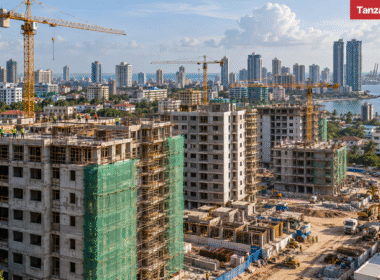
Housing supply in Tanzania is dominated by individual home-builders, who account for over 70% of total supply.
The remainder is delivered by the public sector through national housing programmes, with limited participation from formal private developers.
The first Tanzania Buildings Census in 2022 recorded 14,348,372 buildings nationwide, comprising 13,907,951 on the Mainland and 440,421 in Zanzibar.[4]
Rural areas hosted 10,038,201 buildings compared with 4,310,171 in urban areas.
Dar es Salaam led with 913,707 buildings, followed by Mwanza with 868,430 and Dodoma with 836,909; in Zanzibar, Mjini Magharibi Region led with 177,450, followed by Kaskazini Unguja with 74,764.
Most buildings were single-story (94.4%), with only 0.5% multi-story, and 91.4% were residential, followed by commercial-residential at 3.4%.
Within non-residential stock, 43% is used for commercial purposes, 16.5% for institutional use, and 14.6% for religious activities.
Housing Finance and Mortgages
Access to formal housing finance remains the sector's most binding constraint.
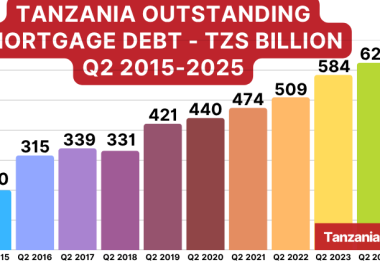
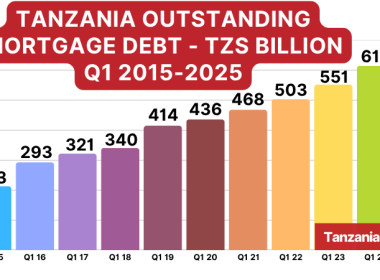
Mortgage finance stands at just 0.29% of GDP, and about 99% of houses are built out-of-pocket, typically over 5 to 10 years instead of the 9 to 12 months a financed build would require.
As of June 2025, 29 different banking institutions were offering residential mortgages in Tanzania.
Consumer loans of up to TZS 150 million (approximately USD 58,000) for up to seven years increasingly compete with mortgages, as they rival mortgage size and tenor while avoiding registration, valuation, and insurance costs.
To deepen long-term funding, a mortgage refinance company was established in 2020 under the World Bank's Housing Finance Project to provide long-term financing to primary mortgage lenders and expand affordable home ownership; as of 31st December 2025, it had 21 shareholders, including the Government of Tanzania and several Tanzanian banks.
Housing Prices in Prime Urban Areas
Dar es Salaam remains the country's prime housing market, with areas such as Upanga, Oyster Bay, Masaki, and Mikocheni concentrating demand for stand-alone houses, villas, and furnished apartments.
Stand-alone houses and villas with at least three bedrooms cost approximately TZS 7.949 million in Upanga, TZS 11.873 million in Oyster Bay, TZS 10.599 million in Masaki, and TZS 6.094 million in Mikocheni.[5]
One-bedroom fully-furnished apartments rent for approximately TZS 1.722 million in Upanga, TZS 2.385 million in Oyster Bay, TZS 2.517 million in Masaki, and TZS 1.113 million in Mikocheni.
Two-bedroom units are priced at approximately TZS 2.385 million in Upanga, TZS 3.180 million in Oyster Bay, TZS 3.180 million in Masaki, and TZS 1.855 million in Mikocheni.
Three-bedroom units rent for approximately TZS 3.974 million in Upanga, TZS 5.300 million in Oyster Bay, TZS 5.017 million in Masaki, and TZS 3.445 million in Mikocheni.
Dodoma has also emerged as a fast-growing housing market following the relocation of the Government from Dar es Salaam that started in 2018, while Mwanza anchors housing demand in the Lake Zone.
Policy Framework
Tanzania's housing and real estate sectors are governed by policies emphasising affordable housing delivery, land tenure security, and private sector involvement.
Vision 2050 Housing Target
The Tanzania Development Vision 2050 targets universal access to safe and clean water and sanitation, affordable clean energy, and decent housing for all Tanzanians.
Land and Housing Policies
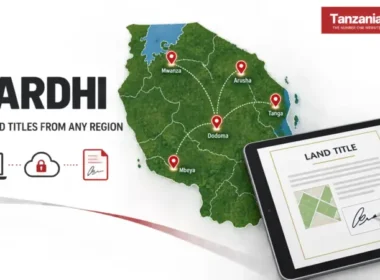
The National Land Policy (1995, revised 2023) provides an updated framework for managing land resources, categorising territory into village, general, and reserve lands, protecting customary ownership, and encouraging private sector participation in land planning, surveying, and real estate development.
The National Human Settlements Development Policy (2000) promotes urban densification, service provision, and shelter for the poor.[7]
Supporting laws include the Land Act 1999 (Cap 113), the Village Land Act 1999 (Cap 114), the Land Use Planning Act 2007, and the Land Registration Act 2009, which govern land allocation, registration, and compulsory acquisition with compensation.
Tax Incentives and Regulatory Reform
In 2023, the Government removed taxes on low-cost housing projects valued below TZS 50 million (USD 19,000), and is currently considering extending this tax relief to homes worth up to TZS 100 million.[8]
A comprehensive Real Estate Act is being finalised to regulate, coordinate, and promote the sector, and includes the proposed establishment of a Real Estate Regulatory Authority to oversee professional standards and maintain a national database of registered agents and developers.
The legislation will also support digital platforms to enhance transparency and provide accurate information on property deals.
Investment Opportunities
Tanzania presents significant opportunities for developers and investors, particularly in the affordable housing sector, where the 3,000,000-unit deficit and 200,000-unit annual demand growth define a long-run development pipeline.
Urban centres such as Dar es Salaam, especially Upanga, Oyster Bay, and Masaki, remain prime locations for new residential development given their burgeoning populations and growing demand for housing.
The relocation of Government functions to Dodoma has opened a second major growth pole for residential and mixed-use projects, while Mwanza offers exposure to the Lake Zone business hub.
Investing in the informal housing sector is a further avenue: approximately 80% of Tanzanian tenant households live in shared accommodation, creating a pressing need to upgrade infrastructure and amenities in informal settlements.
Supporting small-scale landlords to improve rental units can create a more balanced and equitable housing sector while unlocking yield from an under-served tenant base.
On the finance side, the underdeveloped mortgage market (0.29% of GDP) and the tax exemption on low-cost housing below TZS 50 million define a policy-backed opening for affordable-housing developers, mortgage originators, and refinance partners targeting first-time home buyers.
Last Update: May 2026
References
- https://www.nbs.go.tz/uploads/statistics/documents/sw-1738321655-01.%20URT_Demographic%20and%20Socioeconomic%20Profile.pdf (Guide reference #8)
- https://www.nhc.co.tz/img/NHC%20FS%20June%202024%20Audited.pdf (Guide reference #76)
- https://www.tanzaniainvest.com/construction/realestate/housing-demand-2050 (Guide reference #77)
- https://www.nbs.go.tz/uploads/statistics/documents/en-1719124055-04.%20Building_Census2022_English08April.pdf (Guide reference #79)
- https://housingfinanceafrica.org/wp-content/uploads/2025/03/TANZANIA.pdf (Guide reference #80)
- https://www.lands.go.tz/uploads/documents/sw-1742289453-Signed%20Sera%20ya%20Taifa%20ya%20Ardhi.pdf (Guide reference #82)
- https://faolex.fao.org/docs/pdf/tan205478.pdf (Guide reference #83)
- https://www.thecitizen.co.tz/tanzania/news/national/government-mulls-extending-vat-exemption-to-houses-worth-sh100-million-5044400 (Guide reference #84)
Want to know more about Housing in Tanzania? Our free overview of the Tanzania Business and Investment Guide 2026 covers Housing, plus key sectors and investment opportunities. The complete 141-page edition includes policies, taxation, key regulations, full macroeconomic data, and sources, and is also available at no cost upon completion of a short form.
Download Free OverviewGet the Full Edition for Free