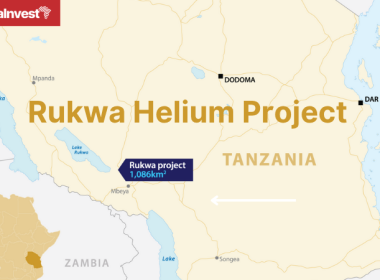



Helium
Tanzania hosts the world's largest known primary helium deposit in the Rukwa Basin, with an estimated 5.7 trillion cubic feet (tcf)[2].
Helium is classified among Tanzania's critical minerals, sitting alongside graphite, uranium, rare earth elements, copper, nickel, cobalt, and lithium as commodities essential for high-tech and green technologies.
The country's helium endowment is concentrated in the Rukwa Basin, where two flagship exploration projects, North Rukwa and Southern Rukwa, are advancing toward development and positioning Tanzania as a potential top-tier global supplier.
Contents
Helium Resource Base in the Rukwa Basin
Tanzania's Rukwa Basin holds the world's largest known primary helium deposit, estimated at 5.7 trillion cubic feet (tcf)[2].
This resource base places Tanzania in a strategically unique position, as most global helium is produced as a by-product of natural gas extraction rather than from dedicated primary deposits.
Exploration in the basin is at an advanced stage, with two principal projects, North Rukwa and Southern Rukwa, currently under development.
The scale of the Rukwa endowment has drawn international attention, given that helium is a non-renewable strategic gas used in medical imaging, semiconductors, aerospace, cryogenics, and scientific research.
North Rukwa Helium Project
The North Rukwa Project has the potential to become the world's fourth-largest helium reserve, ranking behind Qatar, the United States, and Russia.
The estimated prospective helium resource at North Rukwa is approximately 225.5 billion cubic feet (bcf)[3].
If developed at scale, the project would materially reshape the global helium supply landscape, which is currently dominated by a handful of gas-linked producers.
The strategic significance of North Rukwa lies in both its size and the geopolitical diversification it could offer to a market prone to supply shocks.
Southern Rukwa Helium Project
The Southern Rukwa Project is notable for being one of the few helium projects in the world not associated with hydrocarbons or carbon dioxide, positioning it within the "green" helium space.
Gross helium contingent resources at Southern Rukwa have been evaluated at 296 million standard cubic feet, with potential to increase up to 1.35 billion[4].
The "green helium" designation is commercially significant because it avoids the carbon-intensive processing associated with hydrocarbon-linked helium extraction.
This gives Southern Rukwa a differentiated position in downstream markets increasingly attentive to embedded carbon intensity.
Helium Among Tanzania's Critical Minerals
Helium is grouped with Tanzania's critical minerals portfolio, alongside graphite, uranium, rare earth elements, copper, nickel, cobalt, and lithium, all of which are essential for high-tech and green technologies.
In 2023, Tanzania had 11 advanced projects for critical minerals ready for development[1], reflecting a broader push to translate resource endowments into operational production.
Helium is also listed among the country's industrial minerals category, together with gemstones, limestone, soda ash, gypsum, salt, phosphate, and dimension stones such as granite, marble, and sandstone.
The dual classification, as both a critical mineral and an industrial mineral, underlines helium's strategic and commercial importance to Tanzania's mining sector.
Investment Opportunities in Helium
The scale of the Rukwa Basin deposit, at 5.7 tcf[2], offers a rare greenfield entry point into a globally supply-constrained commodity.
North Rukwa's 225.5 bcf prospective resource[3] represents an opportunity to participate in what could become the world's fourth-largest helium reserve, behind Qatar, the United States, and Russia.
Southern Rukwa's positioning in the "green helium" segment, with contingent resources of 296 million standard cubic feet and upside to 1.35 billion[4], opens a differentiated market angle for buyers prioritising low-carbon supply chains.
Downstream opportunities exist in liquefaction, storage, specialty gas logistics, and long-term offtake contracts with medical imaging, semiconductor, and aerospace end-users.
Adjacent opportunities include exploration services, drilling, reservoir engineering, and gas processing infrastructure to support the ramp-up of both Rukwa projects.
Given helium's status as a non-renewable strategic gas with structurally tight global supply, early positioning in Tanzanian helium assets offers exposure to a commodity with limited substitution risk.
Last Update: May 2026
References
- https://eiti.org/sites/default/files/TEITI%2015TH%20EITI%20REPORT.pdf (Guide reference #147)
- https://noblehelium.com.au/wp-content/uploads/2022/04/Helium-In-Tanzania-Linked-File.pdf (Guide reference #152)
- https://api.investi.com.au/api/announcements/nhe/cc9335db-f0c.pdf (Guide reference #153)
- https://polaris.brighterir.com/public/helium_one/news/rns/story/xz461ow (Guide reference #154)
Want to know more about Helium in Tanzania? Our free overview of the Tanzania Business and Investment Guide 2026 covers Helium, plus key sectors and investment opportunities. The complete 141-page edition includes policies, taxation, key regulations, full macroeconomic data, and sources, and is also available at no cost upon completion of a short form.
Download Free OverviewGet the Full Edition for Free