GDP
Tanzania's Gross Domestic Product reached USD 78.84 billion in 2024[1], expanded by an estimated 5.9% in 2025[1], and is projected by the IMF to accelerate to 6.3% in 2026 and 6.5% in 2027[1], positioning the country among the fastest-growing economies in Africa.
Tanzania's economy is the second largest in East Africa after Kenya, which recorded a GDP of USD 120.34 billion in 2024[1], and the 10th largest in Africa[1].
Growth is broad-based across agriculture, financial services, construction, and mining, while long-term policy under Vision 2050 targets a one-trillion-dollar economy with per capita income of USD 7,000[1].
Contents
Tanzania GDP Size in 2024, 2025, and 2026
Tanzania's nominal GDP at current USD stood at USD 78.84 billion in 2024[1], up from an economy that averaged 5.8% annual real growth over the 2015-2024 decade[1].
The Bank of Tanzania (BOT) estimates that Mainland Tanzania GDP grew by 5.5% in 2024 and by 5.9% in 2025[1].
BOT further projects GDP growth in the second half of the 2025/26 fiscal year to accelerate above 6%[1], driven primarily by public investment in railways, roads, airports, and sports facilities, including infrastructure for the 2027 Africa Cup of Nations (AFCON) which Tanzania will co-host[1].
The National Budget 2025/26 targets real GDP growth of 6.0% in 2025, up from 5.5% in 2024[1], while the National Development Plan 2026/27 sets a real GDP growth target of 6.3%[1].
Long-Term Growth Trajectory and Historical Performance
Tanzania's economic performance over the past four decades has been resilient, with real annual GDP growth averaging 3.2% during 1980-1999, rising to 6.5% during 2000-2019, and moderating to 4.9% during 2020-2023[1].
Over the 20 consecutive years between 2002 and 2024, GDP growth averaged 6.2%[1], one of the most sustained expansions in Sub-Saharan Africa.
During 2015-2024, the economy expanded at an average annual rate of 5.8%[1], supported by macroeconomic stability, infrastructure investment, and progressive structural reforms.
The peak of 7.7% growth was recorded in 2011, the fastest since the 1970s[1], during a period of strong FDI in natural gas exploration, telecommunications, and construction.
Sectoral Composition of GDP
Tanzania's economy is relatively diversified across agriculture, industry, and services[1].
During the first three quarters of 2025, the services sector accounted for 36.0% of GDP, industry and construction contributed 32.1%, agriculture represented 24.6%, and taxes on products made up the remaining 7.3%[1].
Agriculture, while contributing about a quarter of value added, remains the largest source of employment, engaging two out of three Tanzanians[1].
The main economic sectors contributing to Tanzania's GDP are agriculture, construction, finance, mining, manufacturing, tourism, trade, and transport[1].
Tourism and hospitality alone contribute approximately 17% to national GDP[1], with the sector drawing over 2.29 million international arrivals in 2025[1].
Under the Long-Term Perspective Plan 2026/27-2050/51, the industrial sector's share of GDP is expected to rise from 32% in 2024 to 40% by 2050, while services are anticipated to expand from 39% to 45% of GDP[1].
Per Capita GDP and Income Convergence
Tanzania's Gross National Income (GNI) per capita, Atlas method in current USD, reached USD 1,210 in 2024[1].
Per capita income has risen substantially from USD 453 in 2000 to USD 1,277 in 2024[1], tripling in nominal terms over two decades.
The country attained World Bank lower-middle-income status in 2020, when its GNI per capita exceeded the USD 1,060 threshold[1].
To achieve upper-middle-income status, Tanzania must surpass the GNI per capita threshold of USD 4,516[1], a milestone the Government targets for 2050 through economic transformation, industrialization, and infrastructure investment.
Vision 2050 sets the goal of an average GDP per capita of USD 7,000[1] within a one-trillion-dollar economy serving more than 118 million people[1].
Regional Comparisons: EAC and SADC Positioning
Within the East African Community (EAC), Tanzania is the second-largest economy after Kenya (USD 120.34 billion in 2024) and ahead of Uganda, Rwanda, and Burundi[1].
Tanzania is also the 10th largest economy in Africa by nominal GDP[1], and a full member of both the EAC, with a combined market of 304 million consumers, and the Southern African Development Community (SADC), covering 366 million people[1].
Tanzania's 2025 estimated growth of 5.9%[1] is comfortably above the projected 4.5% median for the 'B' category of sovereigns tracked by Fitch Ratings[1].
Inflation performance also anchors regional competitiveness, averaging 3.3% in 2025, the lowest in the region compared with Kenya (3.9%) and Uganda (3.6%)[1].
IMF, World Bank, AfDB, and Fitch Forecasts
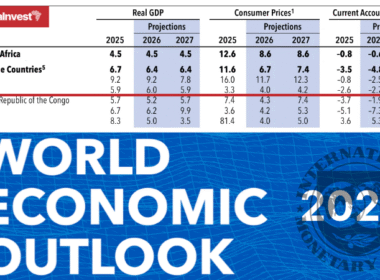
The International Monetary Fund (IMF) projects Tanzania's GDP growth to accelerate to 6.3% in 2026 and 6.5% in 2027[1], with a medium-term projection of 6.5% contingent on decisive reform implementation to preserve macro-financial stability and advance structural reforms[1].
The World Bank forecasts GDP growth of 5.9% in 2026 and 6.1% in 2027[1], spurred by opportunities in the extractives sector, improvements in the business environment, and expanded use of public-private partnerships.
The African Development Bank (AfDB) expects Tanzania to attain an average growth rate of 6% or higher in 2025-26[1], supported by continued public investment in agriculture and energy infrastructure value chains.
Fitch Ratings, in its March 2026 review, reaffirmed Tanzania's Long-Term Foreign-Currency IDR at 'B+' with a Stable Outlook[1], expecting real GDP growth to remain strong at 6% in 2026 and 2027[1], supported by increased agriculture and mining activity plus flagship infrastructure such as the SGR railway and the EACOP pipeline.
Fitch also expects government debt to decrease to 47% of GDP in FY27, from 50% in FY 2025/2026[1], well below the 'B' median of 54%.
Vision 2050 GDP Targets and Financing Requirements
The Tanzania Development Vision 2050 (Dira 2050), released in July 2025[1], sets the ambition of transforming Tanzania into an industrialized, upper-middle-income economy with a USD 1 trillion GDP and per capita income of USD 7,000[1].
Under Pillar 1 (Economic Transformation and Competitiveness), Vision 2050 targets an average GDP growth rate of 8-10% annually[1].
Achieving Vision 2050 requires investments averaging more than 35% of GDP annually, with a targeted Incremental Capital-Output Ratio (ICOR) of 4 or less[1].
The total investment requirement increases progressively across the next five-year phases: USD 183 billion for FYDP IV, USD 289 billion for FYDP V, USD 542 billion for FYDP VI, USD 988 billion for FYDP VII, and USD 1.58 trillion for FYDP VIII[1].
Government revenues are projected to cover approximately 22% of total financing needs, while 57% is expected from FDI and 21% from the domestic private sector and Public and Statutory Corporations[1].
FYDP IV milestones include energy generation capacity surpassing 15,000 MW, 8.5 million new decent jobs, and extreme poverty reduced to below 5%[1].
Last Update: July 2026
References
Want to know more about GDP in Tanzania? Our free overview of the Tanzania Business and Investment Guide 2026 covers GDP, plus key sectors and investment opportunities. The complete 141-page edition includes policies, taxation, key regulations, full macroeconomic data, and sources, and is also available at no cost upon completion of a short form.
Download Free OverviewGet the Full Edition for Free