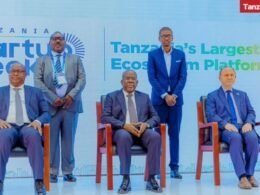

On 2nd July 2026, the Dar es Salaam Stock Exchange (DSE) hosted the final day of the 13th Building African Financial Markets (BAFM) Forum in Dar es Salaam, bringing together capital market leaders, regulators, and financial institutions under the theme of driving capital market growth in Africa through innovation, integrity, and inclusive participation.
Discussions built on Day 1 by focusing on state-owned enterprise listings, Environmental, Social, and Governance (ESG), digital transformation, sustainable finance, exchange-traded funds (ETFs), and cross-border market development across Africa.
Digital innovation emerged as a central theme of the second day, with speakers highlighting how technology is reshaping investor access and participation across African markets.

DSE reported that more than 870,000 investors have now participated in the market, with 265,000 of them joining through digital platforms.
Discussions also highlighted the structural financing challenges facing African economies, with participants noting that SMEs account for approximately 90% of businesses in Africa, employ around 80% of the workforce, and contribute about 55% of GDP.
However, they face a combined funding gap estimated at USD 331 billion, limiting their ability to scale and access long-term capital.
Sustainable finance and ESG investing featured prominently in the discussions.
Participants noted that Africa currently accounts for less than 1% of global ESG issuances despite growing demand.

It was highlighted that the total global sustainable finance market is projected to reach USD 30 trillion by 2030, presenting significant opportunities for African markets.
Data presented by the International Finance Corporation (IFC) showed that sustainability leaders achieve returns above 20% internal rate of return (IRR), while lagging firms record returns below 10%.
ETFs were reinforced as a major opportunity for expanding African capital markets and attracting global capital.
Speakers noted that global ETF assets under management have exceeded USD 23 trillion, while African ETF markets remain relatively small at approximately USD 18 billion, most of which are feeder funds.
The forum also explored the potential role of stablecoins in improving cross-border financial infrastructure.
Stablecoins were discussed as a potential solution to enable near-instant settlement between Central Securities Depositories (CSDs), improving liquidity and reducing transaction friction across African markets.
Participants aired that traditional cross-border settlement systems currently take two to three days, creating inefficiencies in regional capital movement.
In his remarks, Tanzania’s Treasury Registrar, Nehemia Mchechu, noted that Tanzania’s market capitalization has increased from USD 6 billion in 2020 to USD 10 billion currently, effectively more than doubling within five years.
Mchechu stated: “Our total portfolio stands at around 92 trillion TZS… that is around 35 to 40 billion USD on the equity base. If we consider market value, the number could be more than 100 billion.”
He further stated that the market value of these assets could exceed USD 100 billion when fully assessed.
He added that Tanzania’s approach is focused on strengthening state enterprise performance while expanding market participation and mobilising long-term capital.
“We have 252 companies where the government is a majority shareholder… out of which nearly 110 are commercial or semi-commercial enterprises,” stated Mchechu.
He also highlighted that the Tanzanian government is preparing to list four to five utility and commercial companies in the current year as part of efforts to deepen the capital market and improve efficiency of state assets.
In her presentation, the Regional Capital Markets Business Manager for Infotech, Sonia Axon highlighted the scale and operational capacity of digital financial infrastructure supporting capital markets across Africa.
She noted: “Infotech operates a team of 750 professionals serving more than 250 clients across over 20 countries and the platform processes approximately USD 3.5 billion worth of transactions every day.”
Axon emphasized the importance of robust technology infrastructure in enabling efficient, secure, and high-volume financial transactions across multiple jurisdictions.
On his part, the ICT Manager at the DSE, Ali Oman said mobile trading has transformed accessibility, especially among younger investors.
Oman stated: “Mobile trading was only 11,000 investors in 2022, but now we are talking about almost 265,000.”
He added that 74% of new investors are aged between 20 and 39, showing a strong demographic shift towards younger participation in capital markets.
He explained that total digital transaction turnover has reached approximately TZS 425 billion year-to-date, representing a fourfold increase compared to previous years.
On his part, the Director of iTrust Finance, Prof. Mohammed Warsame highlighted the rapid expansion of exchange-traded funds globally and in Africa.
He noted: “The target for the IPO was about 10 million Tanzanian shillings. It raised about 54 million. That subscription rate is massive,5.4 times more than the target price.”
He explained that global ETF assets under management have exceeded USD 23 trillion, reflecting strong institutional and retail participation.
Warsame added that the ETF has delivered a year-to-date return of approximately 29%, demonstrating strong regional investor interest.
In her presentation, the Senior Operations Officer of the International Finance Corporation (IFC), Louise Gardner, highlighted: “The total market for sustainable finance is expected to reach 30 trillion by 2030. 87% of banks now have a sustainability vision, while 92% have board-level oversight of ESG issues.”
In her remarks, the Head of Corporate and Investment Banking from Stanbic Bank, Ester Manasse, highlighted the growing momentum in sustainable finance across Africa.
Ester stated: “Standard Bank Group has pledged about 450 billion rand to sustainable finance for the period 2022 to 2028.”
Manasse emphasized the increasing appetite for sustainable investment instruments across African markets.
On his part, CRDB’s ESG and Sustainability Manager, Rukonge Muhongo highlighted the impact of CRDB Bank’s Kijani Bond in supporting sustainable finance.
Muhongo Stated: “The disbursement of the Kijani Bond is over 250 billion TZS, with a household impact of over 800,000 households.”
He added that the Bond recorded an oversubscription of more than 200%, with over 50% of investors being retail participants.
He explained that the instrument has demonstrated strong participation from retail investors and growing interest in green finance products in Tanzania.
Want to know more about Capital Markets in Tanzania? Our upcoming Capital Markets Guide covers the Dar es Salaam Stock Exchange (DSE), listed companies, bonds, and private equity, plus the regulatory framework for investing in Tanzania’s capital markets.
Learn MoreWant to know more about the Capital Markets in Tanzania? Our free overview of the Tanzania Business and Investment Guide 2026 covers the Capital Markets, plus key sectors and investment opportunities. The complete 141-page edition includes policies, taxation, key regulations, full macroeconomic data, and sources, and is also available at no cost upon completion of a short form.
Download Free OverviewGet the Full Edition for Free