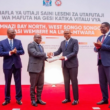




The Central Bank of Tanzania (BOT) pursuant to the provisions of Section 30(1)(a) of the Banking and Financial Institutions Act, 2006, has authorized the merger of Twiga Bancorp Limited and TPB Bank Plc with effect from 17th May 2018.
The new bank after the merger will retain the name TPB Bank Plc. All customers, employees, assets, and liabilities of Twiga Bancorp Ltd will be transferred to the new TPB Bank Plc.
The bank was put under Statutory Management of the Bank of Tanzania with effect from 28th October 2016 following its undercapitalization status.

BOT explains in its public notice that “The new TPB Bank Plc will be adequately capitalized as required by Section 17 of the Banking and Financial Institutions Act, 2006. This measure has been taken to improve the oversight and performance of banks owned by the Government of the United Republic of Tanzania. The Bank of Tanzania would like to assure the public that it will continue to protect the interests of depositors and maintain the stability of the banking sector.”
Formerly known as National Bureau de Change, Twiga Bancorp was established in 1992 as a fully owned subsidiary of the National Bank of Commerce, of which the Government of Tanzania owns 30% of the shares, and was transformed into a non-banking financial institution in 1998.
Previously known as Tanzania Postal Bank, TPB was founded in 1925 under British Rule, to later became a Savings Bank under the then East African Post and Telecommunications which ceased to operate after the collapse of the East African Community.
The Tanzania Posts & Telecommunications Corporation (TP&TC) came into being to cater for the Tanzanian market.
TPB was established by the Tanzania Postal Bank Act No. 11 of 1991 as a separate legal entity from the now-defunct TP&TC along with Tanzania Posts Corporation (TPC) and Tanzania Telecommunications Company Limited (TTCL) which are also separate legal entities.

TPB remains a public institution with the Government of Tanzania holding 86.03% of the shares, Tanzania Posts Corporation holds 8.09% of the shares, the Government of Zanzibar 3.05% of the shares, and TP & TC Savings and Credit Society holding the remaining 2.83% of the shares.
For further clarification, interested parties may contact the Director Banking Supervision, at the Bank of Tanzania:
telephone number +255 22 2235483,
fax number +255 22 2234189
email – kanyoni@bot.go.tz.
Want to know more about Banking in Tanzania? Our free overview of the Tanzania Business and Investment Guide 2026 covers Banking, plus key sectors and investment opportunities. The complete 141-page edition includes policies, taxation, key regulations, full macroeconomic data, and sources, and is also available at no cost upon completion of a short form.
Download Free OverviewGet the Full Edition for Free