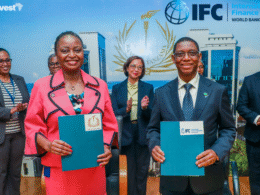




Top executives of the largest banks in Tanzania have met in Dodoma on 26th and 27th November 2021 for the 20th Conference on Financial Institutions organized by the Bank of Tanzania (BOT), under the theme “Tanzania economy: Recovery from COVID-19 pandemic and beyond.”
Among the topics discussed was the crucial issue of high-interest rates, a major factor connected to low access to credit by Tanzanian small and medium enterprises (SMEs), and which has experiencing and slow-down lately.
The event was officiated by the President of Tanzania Hon. Samia Suluhu Hassan, who expressed her satisfaction with the growth of the financial sector and its role in the Tanzanian economy, but also called upon banks to improve lending and reduce interest rates.

In this regard, the CEO and MD of CRDB Bank, the country’s largest bank, and Chairman of the Tanzania Bankers Association (TBA), Abdulmajid Nsekela said lending interest rates would soon start going down, as a number of issues were being deliberated between lenders and the BOT.
Already in July this year BoT has come up with a number of interventions for policy reforms that will induce banks to reduce interest rates soon, among which is a reduction of statutory minimum reserve requirement (SMR), and the introduction of special loan amounting to TZS 1 trillion to banks and other financial institutions for on-lending to the private sector.
Nsekela explained that the banks have been doing simulation and will soon announce reductions on their interest rates that are currently averaging 16%.
He also noted that the banking sector is scaling up the digitalization of its products and services to reach more Tanzanians.
However, he also reminded that the sector is still affected by a high ratio of Non-Performing Loans (NPLs), currently estimated at TZS 1.2 trillion and representing about 9% of gross loans.

In this regard, BOT recently conducted a review to identify the main reasons behind high NPLs and established that, to a great extent, some banks and financial institutions are directly responsible, and introduced new measures in November, which include legal actions against bank employees who issued loans without following procedures, fraud or lack of integrity.
However, the banks reminded that there are other underlying factors to NPLs that need to be addressed.
Muhsin Masoud, Managing Director of the People’s Bank of Zanzibar (PBZ), an institution fully owned by the Government of Zanzibar where it dominates the market, reminded that the cost of funding (high interest rates) is not necessarily the main cause of failing to repay credits, raising concerns about the actual legal consequences for defaulters.
He also reminded that a major problem faced by banks in giving credit is represented by the complexity and length for potential clients to obtain title deeds to be used as collateral.
In this regards Ivan Tarimo, Partner at the advisory firm BANKABLE, shared his assessment of four key areas affecting slugging growth of credit to the private sector in Tanzania, namely monetary policies, fiscal policies, business policies, and regulatory framework.
Tarimo agreed with Masoud in that the regulatory framework is inadequate, and that stronger and better regulations are needed, for example concerning foreclosures.
However, Tarimo also highlighted that the monetary policies introduced by BOT in 2021 are commendable as they ensure adequate liquidity in the market.
The Governor of BOT, Prof Florens Luoga, who answered many regulatory questions that were raised at the conference, reminded that the banking sector continues to be profitable and well-capitalized.
“The ratio for liquid assets-to-demand liabilities grew to 33.3% in 2020/21, compared to the required 20%. This means that banks had adequate liquidity to issue loans to the private sector,” clarified Luoga.
For her part, Ruth Zaipuna, CEO of NMB, Tanzania’s second-largest bank, highlighted actions to scale up private sector credit growth that can be taken by the government, financial institutions, and the private sector.
These include being more customer-centric, leveraging on digital solutions and introducing relevant product offerings to address unique needs; working on capacity building to promote financial literacy; and widening access to credit by improving access and affordability of financial services, and incentivizing lending programs.
She stressed that these actions require a collaborative approach to ensure a sustainable impact on the economy.
And Abdi Mohamed, CEO of ABSA Bank Tanzania, reminded that the ratio of credit to GDP in the country is growing but it is just 13%, a very low figure that gives room for tremendous growth.
Tanzania Banking Sector Report
Want to know more about Banking in Tanzania? Our free overview of the Tanzania Business and Investment Guide 2026 covers Banking, plus key sectors and investment opportunities. The complete 141-page edition includes policies, taxation, key regulations, full macroeconomic data, and sources, and is also available at no cost upon completion of a short form.
Download Free OverviewGet the Full Edition for Free