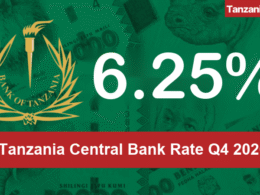


The Bank of Tanzania (BOT) has revised downwards the discount rate at which it lends money to banks to 9% from the prevailing 12% with effect 7th August 2017.
The new rate is at an all time low from the historically high rate of 16%.
As indicated in a BOT circular to banks dated 3rd August 2017, the revised discount rate takes into account the prevailing 91 days and 182 weighted average yields and the prevailing monetary stance.

The discount rate is applicable to banks borrowing from the central bank as a lender of last resort and will also be used to discount the Treasury securities (government papers).
The discount is meant to be passed on to the customers by lowering commercial banks’ lending rates that rose to an average rate of 17.72% in April 2017 from 16.03% in June 2016.
Tanzania Credit Crunch
BOT explains in its latest Monetary Policy Stamenet of June 2017 that the increase in lending rates partly reflects the increased risk premium associated with the rise in Non-Performing Loans (NPLs), whose ratio to gross loans increased to 10.8% at the end of April 2017 from 8.2% at the end of April 2016.
In the same Monetary Policy Stamenet BOT indicates that “liquidity condition in the banking system remained relatively tight [and are] largely attributed to the cumulative impact of the substantial decline in net foreign budgetary inflows and transfer of public institutions’ deposits to the Bank of Tanzania.”
At the end of 2016 BOT added interest rates to its monetary policy instruments, and for the first time since 2013, in March 2017 it reduced the discount rate to 12.0% from 16.0% to ease access to liquidity.

In April 2017 the World Bank (WB) warned that measures to extend access to credit and reducing its cost are urgently required to support the Tanzania’s economic growth and in the same month BOT reduced the statutory minimum reserve (SMR) requirement on private sector deposits to 8.0% from 10.0% to broaden the lending base of commercial banks.
Banks’ Reaction
TanzaniaInvest contacted STANBIC Bank, one of Tanzania’s largest lenders, to comment on this further reduction in the discount rate.
“[The new rate] alleviates the cost factor when liquidating government paper to meet other obligations and increases the ability to leverage balance sheet in certain lines,” Zainul Chandoo, Head of Treasury at STANBIC Tanzania, explained.
However, Chandoo added that whilst the move is positive there are few other adjustments that are key in addressing the credit appetite:
– NPLs remains a challenge with industry average above 10% with subsequent implications on the bottom line. This, therefore, has reduced the credit appetite as the sector battles to manage the ratios and its capital.
– Notable steps of improvements in judiciary system are indeed welcome. There is however still great room in improving turnaround times and efficiency within the judiciary. In turn, this is expected to improve the current backlog and confidence levels in the recovery process.
– Clear policies are essential in improving investor confidence levels. The convergence of private/ public partnership needs to reach to a much greater height to create a win win situation for both parties.
– Laws and regulations (i.e. natural resource, telco act) and ad-hoc changes and introduction tend to spoke an array of business thus creating wait and see climate.
– The funding component on an aspirational fiscal budget is essential in getting infrastructure projects executed. The funding has had its headwinds in the last few years thus impacting implementation of various projects and wider economic benefits it entails.
“Whilst the current transformation is transitory, the opportunities are great and as a bank, we are well positioned to be part of the success story,” Chandoo concludes.
Want to know more about Banking in Tanzania? Our free overview of the Tanzania Business and Investment Guide 2026 covers Banking, plus key sectors and investment opportunities. The complete 141-page edition includes policies, taxation, key regulations, full macroeconomic data, and sources, and is also available at no cost upon completion of a short form.
Download Free OverviewGet the Full Edition for Free