Dangote Industries has confirmed Kenya, not Tanzania, as the site for its planned USD 19 billion oil refinery, but is in separate talks with Tanzania on a 2,000-megawatt coal-fired power plant, a urea fertiliser plant, and port and road investments.
The refinery will be built on Lamu Island, off Kenya’s northern coast.
The decision was confirmed on Tuesday, July 7, 2026, by Edwin Devakumar, Group Vice President for Oil and Gas at Dangote Industries Limited, in on-record comments to Reuters and AFP.

Devakumar said the site has been identified, with soil testing under way and engineering and design work already started, and that construction is expected to take around 30 months once it begins. “Kenya was the choice from the beginning,” he told Reuters.
The project is estimated to cost KSH 2.5 trillion (approximately USD 19.3 billion), according to Dangote Industries.
Financing is planned through a combination of internally generated funds, corporate bond issuances, and proceeds from a future Initial Public Offering (IPO).
The Kenyan government has pledged seed capital of KSH 21.5 billion (approximately USD 166 million) toward the project, according to President William Ruto.
Once operational, the Lamu refinery would raise Dangote’s combined refining capacity across Africa to approximately 2.1 million barrels per day, alongside the company’s existing plant in Lagos, Nigeria.

The refinery is intended to supply refined petroleum products to Kenya, Uganda, Tanzania, South Sudan and other East African markets, reducing the region’s reliance on imported fuel.
Dangote’s refinery in Lagos, the world’s largest single-train facility with a capacity of 650,000 bpd, was commissioned in 2023 and reached full production capacity in February 2026.
The company plans to more than double that plant’s capacity to 1.4 million bpd by 2028.
The Lamu site was chosen after months of regional back-and-forth.
At the inaugural Africa We Build Summit in Nairobi on April 23, 2026, Dangote pledged to build the refinery within four to five years if regional governments backed the project.
President Ruto initially proposed Tanzania’s Tanga port as the site for a joint East African refinery, a plan he presented publicly alongside Dangote and Uganda’s President Yoweri Museveni.
Tanzania’s President Samia Suluhu Hassan said she had not been consulted on the Tanga proposal before it was announced, and later raised the issue directly with President Ruto during his state visit to Dar es Salaam on May 4, 2026.
By May 10, 2026, Dangote told the Financial Times he was leaning toward Mombasa instead of Tanga, citing the Kenyan port’s greater depth and cargo handling capacity for very large crude carriers.
Lamu was ultimately selected over both Tanga and Mombasa as the final site.
Tanzania Investment Talks
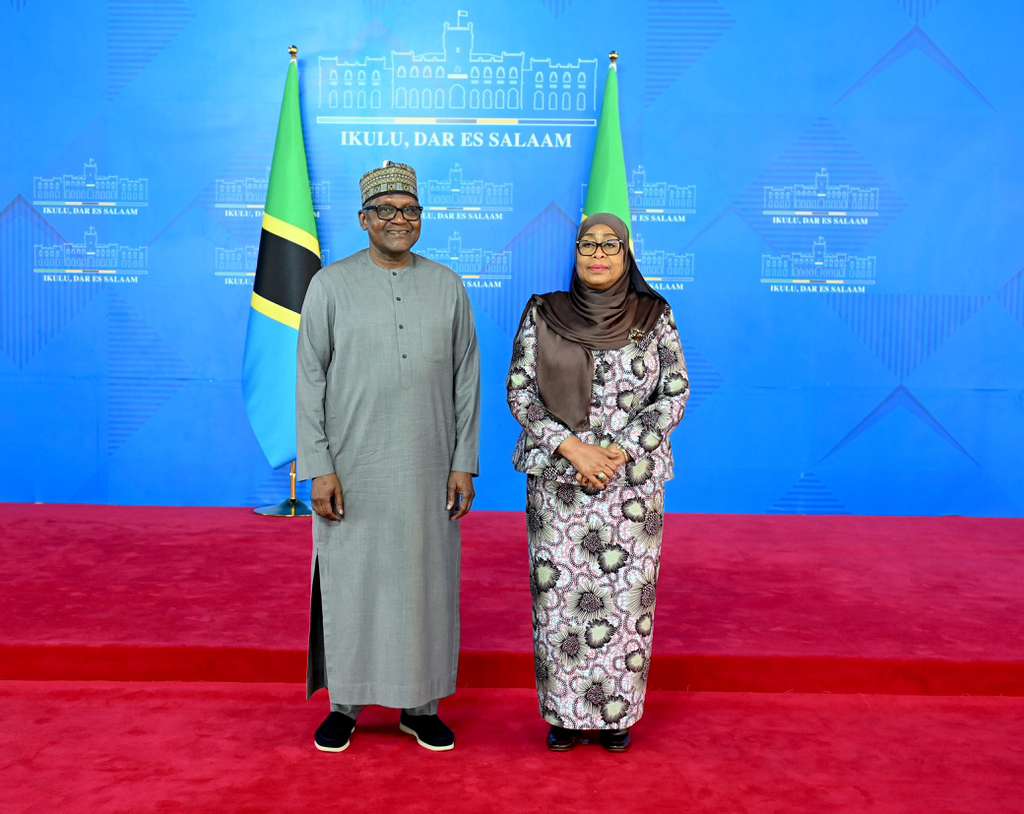
Late last month, Dangote travelled to Tanzania to meet President Samia Suluhu Hassan and explain the Group’s decision to locate the refinery in Kenya, and invited Tanzania to participate as an investor in the Lamu project.
During that visit, on June 29, 2026, Dangote held talks with President Samia Suluhu Hassan on a broader partnership for Tanzania beyond the Lamu refinery.
Dangote said: “We have identified areas that can deliver significant value for Tanzania, and we are ready to work together.”
The two sides identified a 40-kilometre concrete access road for port operations, a special trade zone, a 2,000-megawatt coal-fired power plant, and a urea fertiliser plant as potential investment areas.
They also discussed transport infrastructure linking the southern port of Mtwara with Mbamba Bay, alongside further port development.
President Hassan appointed Prof. Kitila Mkumbo, Minister of State in the President’s Office for Planning and Investment, to coordinate the partnership.
A Tanzanian government delegation is expected to travel to Nigeria to advance the discussions.
Dangote already operates a cement plant in Mtwara, a USD 500 million investment producing 3 million tonnes annually.
Want to know more about Energy in Tanzania? Our free overview of the Tanzania Business and Investment Guide 2026 covers Energy, plus key sectors and investment opportunities. The complete 141-page edition includes policies, taxation, key regulations, full macroeconomic data, and sources, and is also available at no cost upon completion of a short form.
Download Free OverviewGet the Full Edition for Free