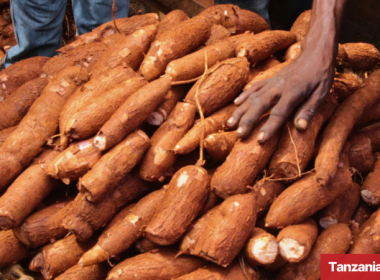



Cassava
Cassava is one of the major food crops driving Tanzania's total food crop production from 17,148,290 tonnes in 2021/2022 to 22,803,316 tonnes in 2023/2024, lifting the country's Food Self-Sufficiency Ratio to 128%.[1]
Cassava is recognised in Tanzania as both a staple food crop and a prioritised commodity for commercial transformation under the Agriculture Master Plan 2050.
Alongside maize, rice, pulses, and bananas, cassava anchors household food security while offering significant value-addition and export potential through processing, market linkages, and corridor-based investment.
Cassava in Tanzania's Food Crop Production
Tanzania's total food crop production rose significantly from 17,148,290 tonnes in the 2021/2022 period to 22,803,316 tonnes in 2023/2024.
This surge raised the country's Food Self-Sufficiency Ratio to 128%, an outcome driven by favorable climatic conditions, improved input supplies, targeted agricultural policies, and coordinated stakeholder efforts.
Cassava is named among the major food crops driving this production increase, alongside maize, rice, pulses, and bananas.
The crop sits within a broader basket that also includes paddy, sorghum, millet, potatoes, sweet potatoes, various roots and tubers, beans, dried oil seeds, vegetables, and fruits.
Agricultural Exports and Market Access
Agriculture remains a vital component of foreign exchange earnings, accounting for 23.6% of total goods exports in 2025.[1]
Tanzania continues to supply established traditional markets, including the European Union (specifically Belgium, Poland, and Germany), the UAE, and Far East markets including South Korea, Indonesia, and China.
The sector is simultaneously expanding into new markets such as the United States.
These external markets provide pathways for cassava-derived products as Tanzania pursues higher processing volumes and value addition under its agricultural transformation agenda.
Cassava as a Prioritised Commodity
Cassava is explicitly listed among the prioritised commodities targeted for accelerated development under Tanzania's agricultural strategy.
The prioritised list also covers fruits (focusing on avocado and banana), spices (focusing on cloves and potatoes), cotton, cashew, sisal, coffee, maize, paddy, sorghum, wheat, sunflower, sesame, soybeans, kidney beans and other pulses, poultry, red meat, dairy, fodder, and aquaculture.
Strategic objectives tied to these commodities include improving market access for farmers, increasing processing of specific commodities tenfold by developing warehouses and market linkages, and lifting regional and international exports to USD 6 billion.
Linkages to more than 2 million smallholders are central to the strategy, positioning cassava as a high-impact crop for inclusive rural growth.
Policy Framework and AGCOT
To accelerate the implementation of the Agriculture Master Plan 2050, the Ministry of Agriculture (MOA) introduced the Agriculture Growth Corridor of Tanzania (AGCOT) initiative in 2025.
It builds on the Southern Agricultural Growth Corridor of Tanzania (SAGCOT), an ambitious public-private partnership initiative launched in 2010 to transform Tanzania's agricultural sector.
SAGCOT focused on improving productivity, food security, and economic growth within the southern region of the country by promoting investments in agriculture and related infrastructure.
The corridor approach covers Tanzania's Central Zone, Southern Zone, Mtwara Zone, and Northern Zone, and is designed to strengthen agricultural production and productivity, improve access to domestic and international markets, enhance capital access, promote crop value addition, and facilitate the availability of agricultural inputs.
The initiative targets a USD 100 billion agricultural GDP, USD 20 billion in net exports, and 10% annual growth, providing a strategic envelope within which cassava production and processing investments can scale.
Cassava Investment Opportunities
The Ministry of Agriculture identifies cassava among the commodities with defined investment opportunities for prospective investors.[2]
The wider opportunity list spans edible vegetable oil seeds (sesame, sunflower, palm oil, soya beans), maize, rice, legumes (pigeon peas, lentils), horticultural crops (grapes, cloves, cut flowers, avocado), cashew nuts, sisal, cotton, and pyrethrum.
Priority areas in production, processing, and export include commercial farming of strategic crops across the agricultural corridors, and productive infrastructure such as irrigation systems and water harvesting facilities.
Additional opportunities cover the supply and local manufacturing of inputs and farm machinery, and post-harvest facilities such as pack houses, cold storage, and warehouses.
Agro-processing facilities for cereals, oilseeds, cashews, sugar, coffee, dairy, and fish form a further investable layer, while export facilitation through auctions, logistics, and crop hubs underpins market access for cassava and other prioritised crops.
Tanzania's extensive water resources, including rivers, lakes, and underground sources, provide significant opportunities for irrigation that can directly raise cassava yields and reliability.
Last Update: May 2026
References
Want to know more about Cassava in Tanzania? Our free overview of the Tanzania Business and Investment Guide 2026 covers Cassava, plus key sectors and investment opportunities. The complete 141-page edition includes policies, taxation, key regulations, full macroeconomic data, and sources, and is also available at no cost upon completion of a short form.
Download Free OverviewGet the Full Edition for Free