

Cashew
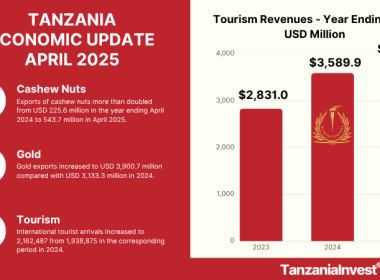
Tanzania's raw cashew production reached 528,263 tonnes in the 2024/2025 season, with 406,362 tonnes sold through the Tanzania Mercantile Exchange digital auction system, generating a total value of TZS 1.46 trillion.
Tanzania is one of the world's leading cashew-producing countries, ranking second in Africa and sixth globally.
The crop is one of Tanzania's flagship traditional cash crops alongside coffee, cotton, tea, and tobacco, and it is among the agricultural commodities driving the country's export expansion into new markets, including the United States.
Cashew Production Performance
Raw cashew production has experienced massive growth, reaching 528,263 tonnes in the 2024/2025 season.
This performance consolidates Tanzania's position as the second-largest cashew producer in Africa and the sixth-largest globally.
Cashew nuts are processed into kernels, while the country also produces cashew nut shell liquid, a valuable byproduct widely used in industrial applications.
The Government and cooperative unions are heavily investing in additional shelling capacity to expand domestic value addition.
Marketing Through the Tanzania Mercantile Exchange
In the 2024/2025 season, a total of 406,362 tonnes of cashews were sold through the Tanzania Mercantile Exchange (TMX) digital auction system.
These auction sales generated a total value of TZS 1.46 trillion, reflecting the depth of the market and the efficiency of digital price discovery for the crop.
The proportion of production passing through the digital auction system illustrates how centralised marketing has become a defining feature of the Tanzanian cashew value chain.
Export Markets and Trade Position
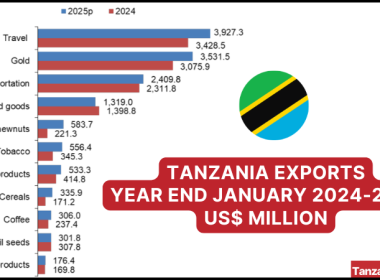
Cashew nuts feature among Tanzania's main exports, with around 44% of national exports, including minerals, tourism, coffee, cashew nuts, cotton, sisal, tobacco, tea, and cloves, destined for Switzerland, India, South Africa, China, and Kenya.
Beyond traditional markets, the cashew sector is actively expanding into new destinations, in particular the United States, supported by a 10% US tariff bracket that places Tanzania in a comparatively favourable position relative to other African nations facing rates of 15% to 30%.
Traditional regional outlets in Asia and the Middle East, including the UAE and Far East markets such as South Korea, Indonesia, and China, continue to anchor demand for Tanzanian agricultural exports.
Agriculture accounted for 23.6% of total goods exports in 2025, underscoring the strategic importance of cash crops such as cashew within the broader external trade balance.
Value Addition and Industrial Use
Cashew nut processing converts raw cashews into kernels, the higher-value product traded on international markets.
In parallel, the country produces cashew nut shell liquid, a valuable industrial byproduct used across multiple downstream applications.
Government investment in additional shelling capacity, together with cooperative union initiatives, is expanding the share of locally processed cashews relative to raw nut exports.
Cashew is also explicitly cited among the priority products for agro-processing facilities, alongside cereals, oilseeds, sugar, coffee, dairy, and fish.
Policy Framework and Strategic Prioritisation
Agriculture Master Plan 2050
Cashew is listed among the prioritised commodities under the Agriculture Master Plan 2050, alongside cotton, sisal, coffee, maize, paddy, sorghum, wheat, sunflower, sesame, soybeans, pulses, fruits, spices, vegetables, poultry, red meat, dairy, fodder, and aquaculture.
Strategic targets at the master plan level include increasing processing of specific commodities tenfold by developing warehouses and market linkages, and raising regional and international exports to USD 6 billion.
Agriculture Growth Corridor of Tanzania (AGCOT)
The Agriculture Growth Corridor of Tanzania initiative, introduced by the Ministry of Agriculture in 2025, covers the Central Zone, Southern Zone, Mtwara Zone (the country's main cashew belt), and Northern Zone.
The corridor framework is designed to strengthen agricultural production and productivity, improve access to domestic and international markets, enhance capital access, promote crop value addition, and facilitate the availability of agricultural inputs.
Headline corridor targets are a USD 100 billion agricultural GDP, USD 20 billion in net exports, and 10% annual sector growth by 2050.
Ministerial Investment Priorities
The Ministry of Agriculture explicitly lists cashew nuts within its summary of investment opportunities by commodity, alongside edible vegetable oil seeds, maize, rice, cassava, legumes, horticultural crops, sisal, cotton, and pyrethrum.
Investment Opportunities in the Cashew Value Chain
Cashew nut processing is identified as a priority area within agro-industries and agro-processing, given Tanzania's position among the world's leading producers and the scope to expand local processing and export of kernels.
Production-side opportunities include commercial farming of strategic crops across the agricultural corridors, with cashew anchoring the Mtwara Zone.
Post-harvest investment angles cover pack houses, cold storage, and warehouses, all relevant to managing seasonal cashew flows and improving auction-ready quality.
Export-facilitation opportunities span auctions, logistics, and crop hubs, building on the established digital auction model that handled TZS 1.46 trillion in cashew turnover in 2024/2025.
Downstream, the production of cashew nut shell liquid offers a distinct industrial pathway, complementing kernel processing and broadening the range of products sold into international markets.
The combination of a 528,263-tonne raw supply base, expanding shelling capacity, and active market diversification toward the United States frames cashew as one of the most investable agricultural value chains in the country.
Last Update: May 2026
References
- https://www.ewura.go.tz/uploads/documents/en-1771937532-Electricty%20Sub-Sector%20Performance%20Updates_Dec_2025.pdf (Guide reference #15)
- https://www.bot.go.tz/Publications/Regular/Quarterly%20Economic%20Bulletin/en/2026020820330341.pdf (Guide reference #66)
- https://www.viwanda.go.tz/uploads/documents/en-1722423611-National%20Trade%20Policy%202003%20Edition%202023_compressed.pdf (Guide reference #133)
- https://ustr.gov/countries-regions/africa/east-africa/tanzania (Guide reference #134)
Want to know more about Cashew in Tanzania? Our free overview of the Tanzania Business and Investment Guide 2026 covers Cashew, plus key sectors and investment opportunities. The complete 141-page edition includes policies, taxation, key regulations, full macroeconomic data, and sources, and is also available at no cost upon completion of a short form.
Download Free OverviewGet the Full Edition for Free