

Agriculture
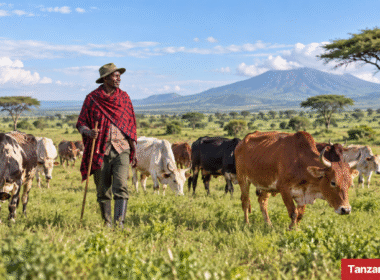
Agriculture contributes 26.3%[1] to Tanzania's GDP in 2024, employs 61.4%[2] of the national workforce, and accounts for 23.6%[2] of total goods exports in 2025.
Tanzania possesses 44 million hectares of arable land out of 94.5 million hectares total land area, yet only 10.8 million hectares (24%) are currently under crop production.
Of the 29.4 million hectares suitable for irrigation, 2.3 million hectares have high potential and 4.8 million hectares have medium potential, indicating substantial scope for productivity gains.
Major food crops include maize, rice, pulses, bananas, and cassava, while major cash crops include cashew nuts, coffee, cotton, tea, tobacco, sisal, sugar, and sunflower.
Key export products include tobacco, cereals, pulses, fruits (especially avocados), and cashew nuts.
Export destinations span the EU (Belgium, Poland, Germany), the UAE, and the Far East (South Korea, Indonesia, China), with cashew exports expanding to the United States.
The sector grew 4.1% in 2024 and 4.0% in the first nine months of 2025[2], supported by 8,970,096 agricultural households nationwide (98.3% engaged in crops and 60.6% in livestock).
Fewer than 4,000 large-scale commercial farms operate across the country, leaving significant room for commercial-scale entry.
Tanzania's 1,424 km coastline and 61,500 sq km of freshwater resources (6.5% of land area) underpin a substantial fisheries and blue economy base.
Crops
The crops sub-sector contributed 16.1% of GDP in 2024 and remains the dominant component of Tanzanian agriculture.
Food crop production expanded from 17,148,290 tonnes in 2021/2022 to 22,803,316 tonnes in 2023/2024.
The Food Self-Sufficiency Ratio reached 128%, positioning Tanzania as a regional food surplus producer.
Food Crops
Food crop production is anchored in maize, rice, pulses, bananas, and cassava, cultivated mainly by smallholder households and increasingly oriented to regional export markets.
Maize
Maize is Tanzania's leading staple food crop, central to the food self-sufficiency surplus and to cereal exports to neighbouring markets.
Cassava
Cassava is among the five major food crops cultivated nationwide and offers significant agro-processing potential.
Potato
Potato production complements the food crop portfolio and supports growing demand from urban centres and the processing industry.
Cash Crops
Tanzania's major cash crops—cashew nuts, coffee, cotton, tea, tobacco, sisal, sugar, and sunflower—drive export earnings and supply growing industrial value chains.
Cashew
Cashew nuts are a flagship export commodity, with markets expanding from traditional destinations to the United States.
Coffee
Coffee remains one of the country's principal cash crops, with established exports to the EU and Far East markets.
Cotton
Cotton supplies both export markets and the domestic textile manufacturing value chain.
Sisal
Tanzania remains a historic global producer of sisal, supplying natural fibre to industrial markets.
Sugar
Sugar is a priority value chain under the Master Plan 2030, with import substitution and capacity expansion as core objectives.
Sunflower
Sunflower is the leading domestic oilseed crop, central to reducing edible oil import dependence.
Horticulture
Horticulture is one of the fastest-growing sub-segments, led by fruit exports—especially avocados—to the EU, the UAE, and Far East destinations including South Korea, Indonesia, and China.
Avocados
Avocados are explicitly identified as a leading fruit export, with rising demand across European and Asian markets.
Mango
Mango production supports both fresh fruit exports and emerging agro-processing investments.
Grapes
Grape cultivation, concentrated in the Dodoma region, supplies Tanzania's growing wine industry.
Fertilizers and Agricultural Inputs
Tanzania has increased domestic fertilizer production through investments such as the new Itracom Fertilizer plant, with production covering organic and mineral fertilizers, phosphate-based fertilizers, liquid fertilizers, compost, and calcium fertilizers.
The country now exports fertilizers to Kenya, the DRC, and Malawi, while Government policy targets reducing chemical fertilizer dependency and boosting domestic fertilizer availability for smallholders and commercial farms.
Livestock
Livestock contributed 7.4% of GDP in 2022 and 26.1% of agricultural GDP, and 6.2% of GDP in 2023, supporting 4.6 million households.
Tanzania has 36.6 million cattle, the second largest herd in Africa after Ethiopia[3], representing 1.4% of the global and 11.0% of the African total cattle population.
Cattle, goat, sheep, and poultry populations grew on average 83% between 2010 and 2022, with cattle numbers more than doubling.
Total livestock value reached TZS 33.22 trillion in 2024/2025, up from TZS 30.49 trillion in 2023/2024.
Meat exports stood at 9,863.41 tonnes valued at USD 44.07 million in 2024/2025, up 5.75% year-on-year, with goat meat accounting for 64.69% of total meat exports.
Tanzanian meat exports reach 11 countries: Bahrain, Comoros, Hong Kong, Jordan, Kenya, Kuwait, Oman, Qatar, Saudi Arabia, the UAE, and Vietnam.
Poultry
Tanzania's poultry sub-sector is characterised by rapid expansion and rising domestic demand, with Poultry and Meat Processing prioritised in Government investment for both the 2024/2025 and 2025/2026 budgets.
There is strong potential for commercial-scale investment in breeding, feed, and processing operations to meet the protein demand of a population of 70 million.
Fisheries and Aquaculture
Fisheries contributed 1.7% of GDP in 2024/2025 and employ approximately 6 million Tanzanians.
Total fish production reached 513,802.47 tonnes in 2023[4], comprising 479,976.62 tonnes from natural water fishing (85% freshwater, 15% marine) and 33,825.85 tonnes from aquaculture (farmed fish, seaweed, seagrass, and sea cucumbers).
The value of harvested fish reached TZS 3,429 billion in 2024/2025, up from TZS 3,174 billion.
Fishery exports reached 44,317.78 tonnes by April 2025, up 7.38% year-on-year, with Nile Perch fillets as the main fishery export product.
Tanzania's 1,424 km coastline and 61,500 sq km of freshwater resources form the foundation of the country's Blue Economy ambition under the National Blue Economy Policy 2024.
Aquaculture
Aquaculture contributed 33,825.85 tonnes in 2023, including farmed fish, seaweed, seagrass, and sea cucumbers, and the Government actively encourages investment in fish cage farming and deep-sea aquaculture.
Marine aquaculture investment opportunities include sea cucumber, crab, and seaweed, all positioned as key components of Tanzania's Blue Economy strategy.
Agribusiness
Agribusiness sits at the heart of Tanzania's transformation agenda, with the Agricultural Master Plan 2030 targeting USD 3 billion in agro-processing value and USD 6 billion in net agricultural exports.
The Plan targets a tenfold increase in processing capacity for specific commodities across priority value chains: cereals, oilseeds, cashews, sugar, coffee, dairy, and fish.
Smallholder Farmers
Tanzania's 8.97 million agricultural households (98.3% in crops, 60.6% in livestock) form the backbone of the sector, with smallholders typically cultivating less than five hectares with limited input use and high rainfed reliance.
The Master Plan 2030 targets an average smallholder annual income of USD 1,500 (TZS 4 million), supported by initiatives such as PASS Trust, which has provided TZS 2.6 trillion in credit guarantees to 1.5 million smallholders, and the flagship programme to digitally register 9.9 million farmers and finance 1.7 million beneficiaries and 30,000 SMEs.
Policy Framework
Tanzania's agricultural policy direction is set by the Agricultural Master Plan 2050[5], which provides the long-term roadmap for sector transformation.
The 2030 mid-term ambition[6] targets 10% annual growth, +50% productivity, USD 1,500 smallholder income, USD 3 billion in agro-processing, and USD 6 billion in net exports.
The Plan identifies 15 flagship initiatives and 20 prioritized commodities, including wheat, soybeans, poultry, aquaculture, fertilizer, and fodder.
Flagship initiatives include enhancing food security, unlocking 1.5 million hectares for commercial agriculture, securing 1.2 million hectares of land ownership, expanding irrigation to 1.2 million hectares, improving soil health, quintupling seed production, digitally registering 9.9 million farmers, financing 1.7 million beneficiaries and 30,000 SMEs, scaling market linkages for 2 million smallholders, and increasing processing tenfold.
AGCOT
The Agriculture Growth Corridor of Tanzania (AGCOT) was launched in 2025 by the Ministry of Agriculture, building on SAGCOT (Southern Agricultural Growth Corridor of Tanzania), which was launched in 2010 as a public-private partnership.
AGCOT covers four zones—Central Zone, Southern Zone, Mtwara Zone, and Northern Zone—and targets USD 100 billion in agricultural GDP, USD 20 billion in net exports, and 10% annual sector growth.
TADB
The Tanzania Agricultural Development Bank (TADB) is the apex agricultural financing institution and is central to the Master Plan's financing flagship targeting 1.7 million beneficiaries and 30,000 SMEs.
Investment Opportunities
Commercial farming presents a major opportunity across Tanzania's 33.2 million hectares of uncultivated arable land, offering scale rarely available elsewhere on the continent.
Irrigation development is another high-potential entry point, covering 2.3 million hectares of high-potential and 4.8 million hectares of medium-potential irrigable land suited to both staple and horticultural production.
Agro-processing aligns with the USD 3 billion Master Plan 2030 target, with gaps across grain milling, edible oils, dairy, and horticultural value addition that remain largely unfilled.
Fertilizer manufacturing is an emerging local-substitution play, following recent domestic plant models that reduce import dependence and serve regional markets.
Poultry and meat processing have been explicitly prioritised in the 2024/2025 and 2025/2026 national budgets, signalling policy support for hatcheries, feed mills, abattoirs, and cold-chain investments.
Aquaculture under the National Blue Economy Policy 2024 opens entry points in fish cage farming, deep-sea aquaculture, sea cucumber, crab, and seaweed cultivation along the coast and inland lakes.
Cross-cutting value chains form part of a USD 100 billion regional agricultural growth ambition, supported by development banks, credit guarantee schemes, and one-stop investment facilitation for financing and entry.
Last Update: May 2026
References
- https://www.kilimo.go.tz/uploads/speeches/sw-hotuba_yabajeti25_26.pdf (Guide reference #65)
- https://www.bot.go.tz/Publications/Regular/Quarterly%20Economic%20Bulletin/en/2026020820330341.pdf (Guide reference #66)
- https://openknowledge.worldbank.org/server/api/core/bitstreams/3ae63843-d8c3-4708-8947-24faf928ec88/content (Guide reference #68)
- https://www.mifugouvuvi.go.tz/uploads/documents/en-1756496407-Sera%20ya%20Taifa%20ya%20Uchumi%20wa%20Buluu%20ya%20Mwaka%202024.pdf (Guide reference #69)
- https://tanzaniaslovakia.sk/ws/media-library/21b3183f837a4485af13f5a885da3938/tanzania-agriculture-master-plan-2050_master-plan_.pdf (Guide reference #70)
- https://www.kilimo.go.tz/uploads/text-editor/files/8.%20AGENDA%2010-30%20DOCUMENT_1757321538.pdf (Guide reference #71)
Want to know more about Agriculture in Tanzania? Our free overview of the Tanzania Business and Investment Guide 2026 covers Agriculture, plus key sectors and investment opportunities. The complete 141-page edition includes policies, taxation, key regulations, full macroeconomic data, and sources, and is also available at no cost upon completion of a short form.
Download Free OverviewGet the Full Edition for Free