Graphite
Tanzania hosts an estimated reserve of 18 million tonnes of graphite, representing 6% of the world's graphite reserves, a vital component for producing anodes in lithium-ion batteries.[4]
Graphite is one of Tanzania's most strategically positioned critical minerals, anchoring the country's role in the global lithium-ion battery supply chain.
With rising demand for battery minerals, Tanzania is emerging as a key supplier in the global transition to renewable energy technologies.
The Government has consolidated this position through active projects in Lindi, Ruangwa, Handeni, Ulanga, Nachingwea, Mirerani, and Simanjiro, alongside new domestic processing capacity commissioned in 2025.
Contents
Reserves and Global Position
Tanzania hosts an estimated reserve of 18 million tonnes of graphite, equal to 6% of the world's graphite reserves.[4]
Graphite is classified among Tanzania's critical minerals, a group that also includes uranium, rare earth elements, copper, nickel, cobalt, lithium, and helium, all essential for high-tech and green technologies.
The mineral is a vital input for producing anodes in lithium-ion batteries, linking Tanzania directly to the global electric vehicle and energy storage value chain.
Tanzania is positioned as a key supplier in the global transition to renewable energy technologies, given rising demand for battery minerals like graphite and nickel.
Active Graphite Projects
As of 2023, there were 11 advanced projects for critical minerals ready for development, of which six were graphite projects located in Ulanga, Nachingwea, and Lindi districts.[3]
In addition, three graphite projects were already in production: Lindi Jumbo Graphite in Lindi district, Permanent Minerals in Mirerani (Simanjiro district), and GodMwanga Graphite Project in Handeni district.
This makes graphite one of the most advanced segments within Tanzania's critical minerals portfolio, with a clear pipeline from exploration to commercial operation.
Production Capacity and Outlook
The Lindi Jumbo graphite mine in Ruangwa has reached an annual production capacity of 40,000 tonnes, based on a confirmed reserve of 5.5 million tonnes, with production expected to last 24 years.
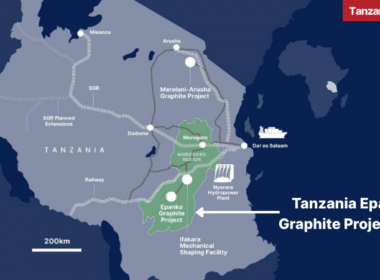
The Mahenge and Epanko graphite mines, once operational, are set to produce more than 60,000 tonnes each.
Overall, Tanzania is projected to produce over 300,000 tonnes of graphite within the next seven years, strengthening its role in the supply chain for lithium-ion batteries.
Domestic Processing and Value Addition
Tanzania is transitioning from raw mineral exports to processing strategic minerals domestically.
In 2025, the country launched its first graphite processing factories in Handeni, producing high-purity mineral concentrates for export.
Graphite was also identified, alongside rare earth elements, nickel, iron, copper, and cobalt, as one of six critical minerals with the highest potential for domestic value addition, based on both current production and regional import demand for intermediate and end-use products.
Policy Framework
The Government has taken a firm stance that no medium-scale (ML) or large-scale (SML) mining licenses will be issued for critical or strategic minerals, including graphite, unless the investor has a clear plan for domestic value addition through local processing or refining.[1]
This approach ensures that Tanzania does not merely export raw graphite but captures greater economic value and creates jobs within the country.
The policy is reinforced by a broader mining governance environment in which Tanzania was ranked the 4th most attractive destination for mining investment in Africa and 3rd for its mineral potential.[2]
The Ministry of Minerals (MOM), established after the 2017 split of the former Ministry of Energy and Minerals, oversees the licensing and value-addition framework applicable to graphite.
Investment Opportunities
Graphite offers investment entry points across the full mineral value chain, from exploration to battery-grade processing.
Mineral exploration is open in new prospective areas, complementing the six graphite projects already advanced for development in Ulanga, Nachingwea, and Lindi.
There are opportunities to establish mineral processing plants for ore preparation and concentration before smelting or refining, building on the graphite processing factories commissioned in Handeni in 2025.
Downstream, mineral beneficiation and value addition activities are prioritized by the Government's licensing policy, creating scope for high-purity concentrate lines, anode-grade graphite processing, and integrated supply arrangements with lithium-ion battery manufacturers.
Additional opportunities exist in supporting infrastructure such as accredited mining laboratories, logistics, and trading hubs that serve graphite alongside other critical minerals.
Last Update: May 2026
References
- https://www.madini.go.tz/media/HOTUBA_YA_WIZARA_YA_MADINI.pdf (Guide reference #138)
- https://www.fraserinstitute.org/sites/default/files/2026-02/annual-survey-of-mining-companies-2025.pdf (Guide reference #140)
- https://eiti.org/sites/default/files/TEITI%2015TH%20EITI%20REPORT.pdf (Guide reference #147)
- https://manufacturingafrica.org/wp-content/uploads/2025/09/Tanzania-Minerals-Value-Addition-Perspective_Core-Report.pdf (Guide reference #148)
Want to know more about Graphite in Tanzania? Our free overview of the Tanzania Business and Investment Guide 2026 covers Graphite, plus key sectors and investment opportunities. The complete 141-page edition includes policies, taxation, key regulations, full macroeconomic data, and sources.
Download Free OverviewGet the Full Guide