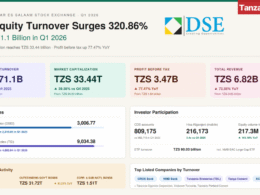


The Dar es Salaam Stock Exchange (DSE) market capitalization reached TZS15.4tn in November 2021 from less than TZS6tn in 2010. Currently (2021),
As of November 2021, there are 28 companies listed at the Dar es Salaam Stock Exchange (DSE) with a total market capitalization of TZS 15,4 trillion.
The DSE All Share Index (DSEI), which comprises all listed companies at DSE, reached TZS 1,858.26 on 29th November 2021.

At the end of August 2021, the total amount of outstanding corporate bonds was TZS 120 billion issued by four entities: EXIM Bank, National Microfinance Bank (NMB), and Tanzania Mortgage Refinance Company (TMRC).
Table of Contents
History of Capital Markets in Tanzania
Tanzania Capital Markets Players
Dar es Salaam Stock Exchange Listed Companies
Stock Exchange Brokers in Tanzania
Tanzania Outstanding Government/Corporate Bonds
Dar es Salaam Stock Exchange Performances
Tanzania Indices Performances
Tanzania Stocks Performances
Tanzania Bonds Performances
Tanzania Capital Markets Outlook
History of Capital Markets in Tanzania
In 1996, the Tanzanian stock exchange was incorporated as a private company limited by guarantees (a non-profit making body) and became operational in 1998.
The first company to list at DSE was Tanzania Oxygen Limited (DSE:TOL) in 1998, which was also the first state-owned company selected for privatization through the capital markets.
This was followed by Tanzania Breweries Limited (DSE:TBL), Tanzania Cigarette Company (DSE:TCC), Swissport (DSE:SWIS), Tanzania Portland Cement Company (DSE:TPCC), Tanga Cement Company Limited (DSE:TCCL) and National Microfinance Bank (NMB).
Following these first state-driven listings, other private companies decided to list at DSE as a part of their corporate growth strategy to raise capital.
These include TATEPA, CRDB Bank, DCB Commercial Bank, and Precision Air that listed at the DSE during 1999–2011.
The latest company to list at DSE is Mucoba Bank (DSE:MUCOBA), after raising a capital of more than TZS2b during its IPO in June 2016.
In 2013, the DSE launched a second tier market, the Enterprise Growth Market (EGM) with lower listing requirements.
The EGM is designed to attract small and medium companies with high growth potential. So far, the EGM has attracted 5 companies, including YETU Microfinance Bank, Mkombozi Commercial Bank, Maendeleo Commercial Bank, Mwalimu Commercial Bank, and Swala Oil & Gas.
In 2015, the DSE was demutualized, i.e. it changed its registration status from being limited by guarantee to being limited by shares.
Moremi Marwa, CEO of DSE, explained that the bourse aims at maximizing the value of investment through the process of demutualization.
The DSE is the third Exchange in Africa to demutualize after the Johannesburg Stock Exchange (JSE) and the Nairobi Securities Exchange (NSE).
In May 2016, the DSE launched its own IPO of 15m ordinary shares at TZS500 per share. The Tanzanian bourse raised TZS35.8b from more than 3,000 investors, which is equivalent to 377% in excess of the targeted capital.
Following the oversubscribed IPO, the bourse exercised the green shoe option of 35% to take up an additional TZS2.6b.
After exercising the option, the total capital raised from the DSE IPO is TZS10.1b. In July 2016, following the successful DSE IPO, the Tanzanian bourse listed itself at the secondary market under the ticker “DSE”.
Tanzania Capital Markets Players
Currently (2016), there are 24 listed companies at the DSE, 11 stockbrokers/dealers and 3 custodian banks.
The custodian banks at the DSE include Standard Chartered Bank Tanzania, CRDB Bank, Stanbic Bank.
Dar es Salaam Stock Exchange Listed Companies
[table “5” not found /]Stock Exchange Brokers in Tanzania
| Stockbrokers/Dealers at the Dar es Salaam Stock Exchange |
|---|
| Core Securities Ltd |
| Tanzania Securities Limited (TSL) |
| TIB RASILIMALI LIMITED |
| SOLOMON Stockbrokers Limited |
| Orbit Securities Company Limited (ORBIT) |
| Vertex International Securities Ltd |
| E. A. CAPITAL |
| Zan Securities |
| OPTIMA CORPORATE FINANCE |
| ARCH FINANCIAL & INVESTMENT ADVISORY LIMITED |
| SMART STOCK BROKERS |
Tanzania Outstanding Government/Corporate Bonds
Outstanding corporate bonds in Tanzania include Exim bank, National Microfinance Bank (NMB), PTA, Stan.
NMB was the latest bank in Tanzania to list bonds at the DSE. The bank listed a TZS41.4b 3 year bond on July 19th 2016. The listed bond carries an interest rate of 13% per annum and is set to mature in 3 years.
Currently (2016), the Government issues bonds that mature after a period of 2, 5, 7, 10 and 15 years.
Tanzania’s treasury bonds yield interest rates of 7.82%, 9.18%, 10.08%, 11.44% and 13.5% respectfully.
Dar es Salaam Stock Exchange Performances
The market capitalization of Tanzania’s bourse, the DSE grew at a rate of 110% per year over the past 5 years, reaching TZS22tn in August 2016 from less than TZS6tn in 2010.

The DSE liquidity grew at a rate of 56% annually since 2010, reaching an average turnover of over TZS800b per year.
Tanzania Indices Performances
- The DSE All Share Index (DSEI), which comprises all listed companies at DSE, rose to 2,550.91 points on August 30th 2016, compared to 1,611.49 on the corresponding date in 2013. This represents an increase of 58%.
- The Tanzania Share Index (TSI), which measures the performance of all local listed companies at the DSE, reached 3,954.41 points on August 30th 2016, compared to 1,962.67 on August 30th 2013. This represents an increase of more than 100%.
- The Industrial & Allied (IA) index increased by 134% to 5,055.12 points on August 30th 2016 from 2,163.38 on the corresponding date in 2013.
- The Banks, Finance & Investment (BI) rose by 49% to 2,900.61 points on August 30th 2016 from 1,941.43 on the corresponding date in 2013.
Tanzania Stocks Performances
Some of Tanzania’s best performers include:
- TBL closed at TZS13,350 on August 30th 2016, compared to 3,720 on August 30th 2013, representing an increase of 259%.
- TCC traded at 11,750 on August 30th 2016, compared to 6,860 on August 30th 2013 (+71%).
- NMB traded at 2,750 on August 30th 2016, compared to 1,820 on August 30th 2013 (+51%).
- CRDB traded at 290 on August 30th 2016, compared to 270 on August 30th 2013 (+7%).
- DSE closed at TZS935 on its first day of trading at the secondary market on July 12th 2016 after being listed at the price of TZS500, representing an increase of almost 100%. On August 30th 2016, the DSE closed at TZS1,000.
Tanzania Bonds Performances
The total amount of corporate bonds in Tanzania issued since the DSE‘s inception is over TZS477b.
An increase in the amount of Tanzanian government bonds traded in the secondary market has been recorded at almost 94% since 2011.
Tanzania Capital Markets Outlook
The Capital Markets and Securities Authority (CMSA) in collaboration with the DSE and various stakeholders are in the process of introducing new products in the Tanzanian stock exchange, both for capital raising and for risk management purposes. These include:
- Real Estate Investment Trusts (REITs)
DSE has made progress towards future listings of REITs, a regulated investment vehicle that enables individuals to collectively contribute funds as consideration for the acquisition rights in a trust with the intention of earning income from the real estate as the underlying asset of the trust.
- Futures and Derivative
DSE plans to introduce derivative products, which will enable investors to buy or sell specific quantities of the underlying asset at a specified prices and delivery time in future.
- Exchange Traded Funds (ETFs)
There are plans by the CMSA and DSE to introduce ETFs whereby unlisted investment fund will be invited to list and trade in the DSE.
- Closed Ended Collective Investment Schemes
These schemes which are currently championed by the CMSA and DSE will give an opportunity for the majority of Tanzanians to invest through buying shares or units of a fund during the initial public offer or through private placement and obtain a return on investment units that will be issued through IPO are then traded on the DSE. The schemes will be structured such that they provide an opportunity to both low and high income individuals and organizations.
- Municipal Bonds
The CMSA, DSE and other stakeholders have set plans to continue to engage some qualifying local Governments into issuing Tanzanian municipal bonds to support the financing of various municipal projects and other long-term capital financings needs.
Pius Maneno, Chairman of DSE, said: “To this end and upon full implementation of a number of its strategic initiatives DSE will be able to accelerate the financial and especially capital market development in the country.”
“We envisage further growth of our income and profitability in the coming years especially following the outcome of demutualization and self-listing.”]
Tanzania is also expected to open its first commodities exchange for trading, the Tanzania Mercantile Exchange (TCX), by the end of 2016.
TCX has been already registered under the name Tanzania Commodity Exchange Market Company Ltd and the trading floor will be located at the LAPF building in Kijitonyama from Kinondoni Disctrict, Dar es Salaam.
According to the CMSA, the TCX will initially trade in six crops called cashew nuts, coffee, sesame, rice, sunflower seeds and probably maize.
In addition, the TCX will provide price transparency and discovery while reducing transaction costs to help setting competitive spot prices and foment the supply and demand.
Want to know more about the Capital Markets in Tanzania? Our free Tanzania Business and Investment Guide 2026 covers the Capital Markets, plus regulations, key sectors, and investment opportunities — all in one place.
Download Free Guide